How Much Does the Annapurna Circuit Trek Cost?
The Annapurna Circuit Trek with Index Adventure starts at USD 985 per person for the 12-day guided package. That covers your permits, licensed guide, accommodation on the trek, most meals, and all ground transport on the itinerary. For context, a standard guided Annapurna Circuit in 2026 runs roughly USD 900 to 1,800 per person depending on the operator, group size, and level of comfort, so this sits at the honest, well-run end of that range rather than the inflated one.
Price drops as group size grows, because shared costs like the guide and transport spread across more people. Here is how it works.
|
Package tier
|
Notes
|
|
Standard group (join a fixed departure)
|
Best value; small group
|
|
2 people (private)
|
Private guide, your own dates
|
|
Solo (private, 1 person)
|
Solo supplement applies
|
|
Larger group (6+)
|
Per-person discount
|
|
Private / custom itinerary
|
Fully tailored, any dates
|
Annapurna Circuit Trek Cost for Nepali Trekkers
Nepali citizens pay less, mainly because the ACAP permit for Nepalis and SAARC nationals costs a fraction of the foreigner rate (NPR 1,000 versus NPR 3,000), and domestic trekkers usually need lighter support.
To plan your spending money on top of the package, budget for drinks, snacks, hot showers, charging, WiFi, and tips. A realistic figure is USD 15 to 25 per day in personal costs on the trail, more if you like a hot shower and a beer at altitude, where everything costs more because it was carried or flown in.
Fixed Departures of Annapurna Circuit Trek for 2026 and 2027
We run guaranteed group departures through both trekking seasons. Join a fixed date below, or ask us to set a private departure on dates that suit you.
|
Season
|
Departure window
|
Availability
|
|
Autumn 2026
|
Late September to late November
|
Booking now
|
|
Spring 2027
|
March to May
|
Booking now
|
|
Autumn 2027
|
Late September to late November
|
Booking now
|
|
Private departures
|
Any month, on request
|
Year-round
|
Autumn and spring dates fill first, especially October, the single most popular month on the circuit. To hold a place on a peak-season departure, book the Annapurna Circuit Trek early.
How Difficult Is the Annapurna Circuit Trek?
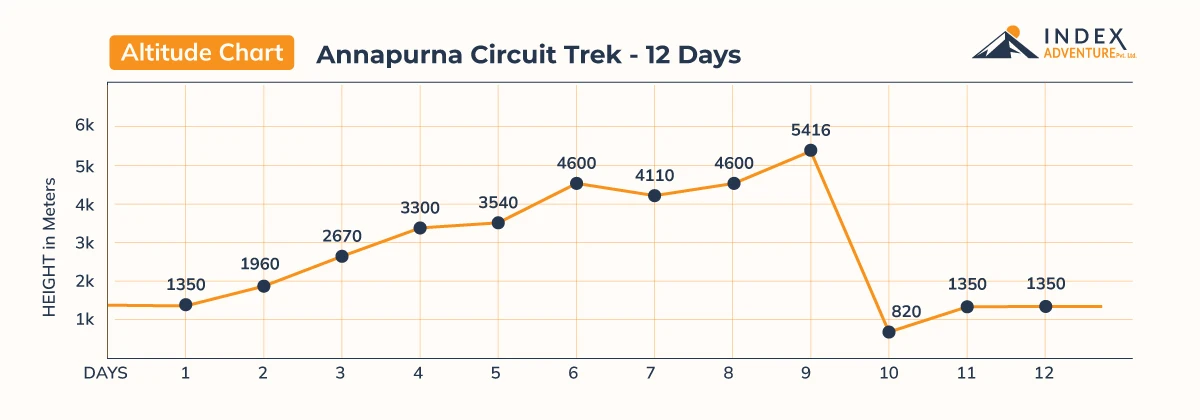
The Annapurna Circuit is a moderate to challenging trek. The walking itself is not technical, there is no climbing or rope work, but the altitude and the length make it demanding. The hardest single element is Thorong La Pass at 5,416 meters, crossed on a long day that starts before dawn and involves more than 1,600 meters of descent afterward.
You do not need prior high-altitude experience, but you do need to be fit enough to walk five to seven hours a day for over a week, on uneven ground, at altitude. Regular hikers with a base of cardio fitness manage it well. The people who struggle are usually those who arrive unprepared or who push the altitude too fast. Our itinerary is built to prevent the second problem, and a few months of hill walking or stair training solves the first.
For a full breakdown of the physical demands, see how difficult the Annapurna Circuit Trek really is, and if you are new to trekking at altitude, read whether beginners can do the Annapurna Circuit. To arrive ready, our guide on how to prepare for the Annapurna Circuit Trek lays out a training plan.
Best Time for the Annapurna Circuit Trek
The two best windows are autumn (late September to November) and spring (March to May). Autumn brings the clearest skies of the year, stable weather, and sharp mountain views after the monsoon has washed the air clean. Spring brings warmer days and the rhododendron forests of the lower valleys in full bloom, hillsides burning red and pink for weeks.
Winter (December to February) is possible but cold and risky at the pass, where deep snow can close Thorong La for days. Monsoon (June to early September) brings rain, leeches, and cloud to the lower trail, though the upper section beyond Manang sits in the rain shadow and stays relatively dry, which is why some experienced trekkers still go then.
If you can only pick one, October is the classic choice: dry, clear, and reliably beautiful, though also the busiest. For a quieter walk with good weather, aim for the second half of November or late March.
Season shapes everything from what you pack to whether the pass is even open. For a month-by-month view, see the best time for the Annapurna Circuit Trek, the specific case for trekking the Annapurna Circuit in September, and the detailed Annapurna Circuit weather and temperature guide.
Annapurna Circuit Trek Distance and Route
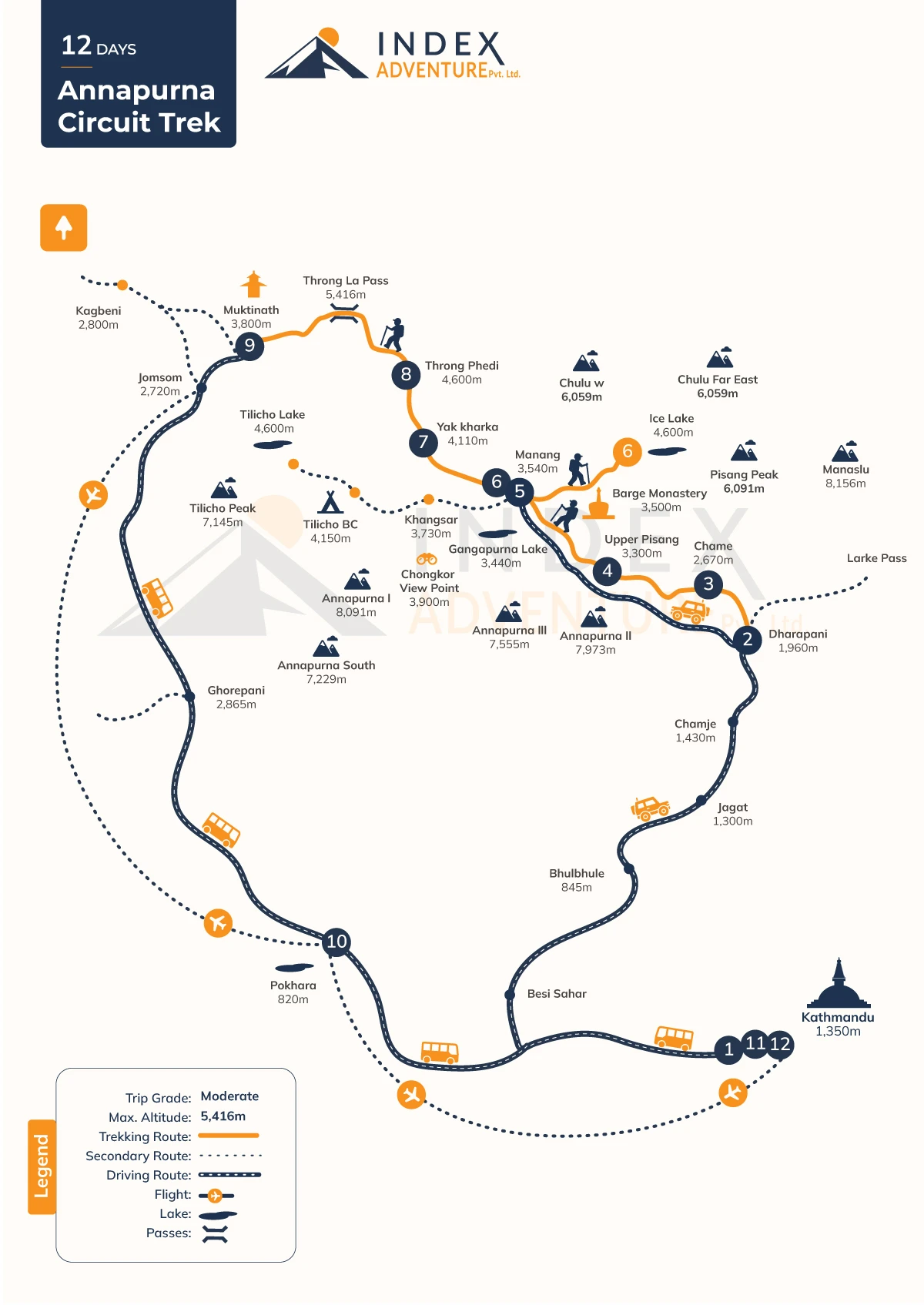
The classic full Annapurna Circuit runs about 160 to 230 kilometers depending on where you start and finish and which side trails you take. Because roads now reach up both the Marsyangdi and Kali Gandaki valleys, most trekkers, including on this 12-day version, walk the high central section and drive the valley approaches. That cuts the on-foot distance to roughly 100 to 120 kilometers of the best walking, centered on the Dharapani-to-Muktinath stretch over Thorong La.
The route is a loop, not an out-and-back, which is part of its appeal: you never retrace your steps. You go up one great river valley and come down another, crossing the watershed at the pass. For the exact mileage and how it breaks down day by day, see how many miles the Annapurna Circuit Trek is and how long the Annapurna Circuit Trek takes.
Thorong La Pass: The High Point of the Trek
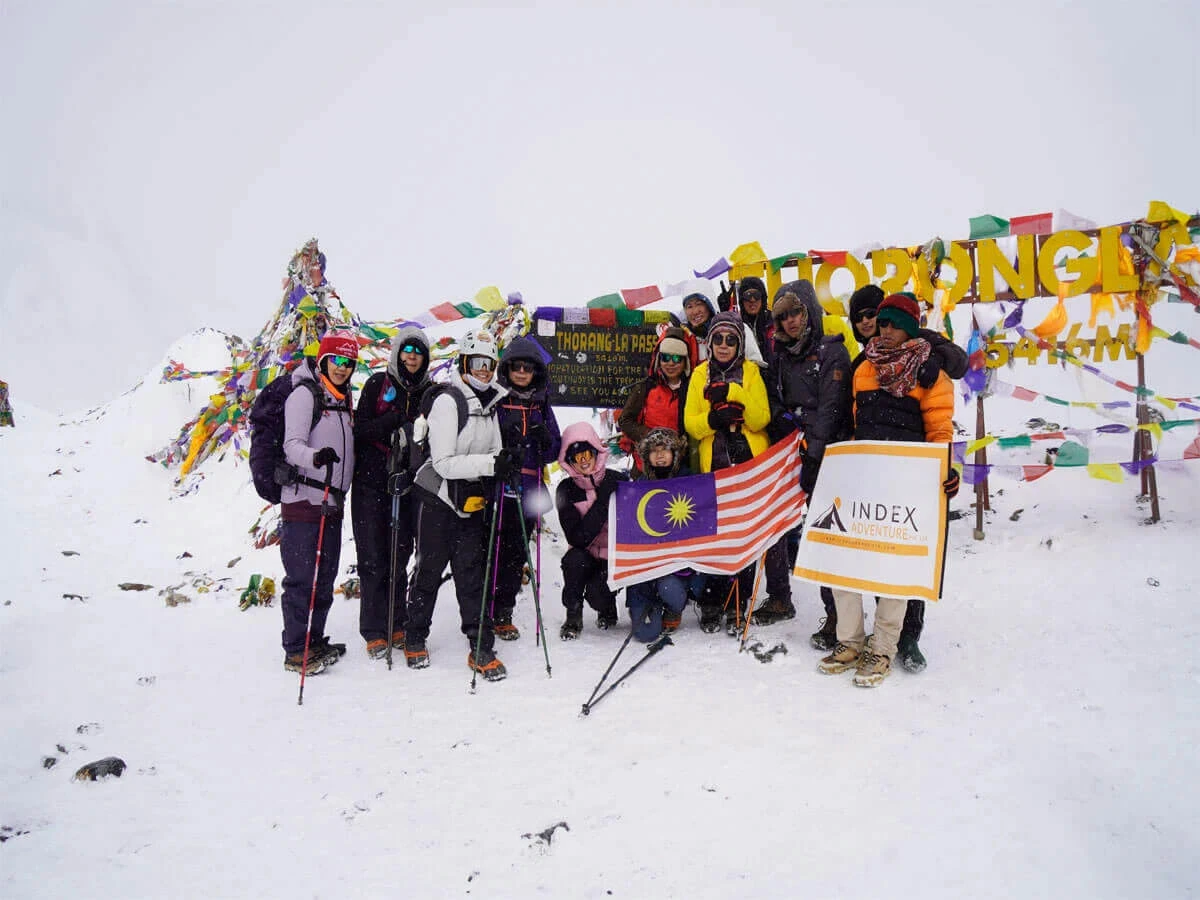
Thorong La Pass, at 5,416 meters (17,769 feet), is the highest point of the Annapurna Circuit and the crux of the entire trek. It is a high saddle between the Khatung Kang and Yakawa Kang peaks, connecting the Manang valley in the east to Mustang in the west. Crossing it is the reason the trek is graded as demanding rather than moderate.
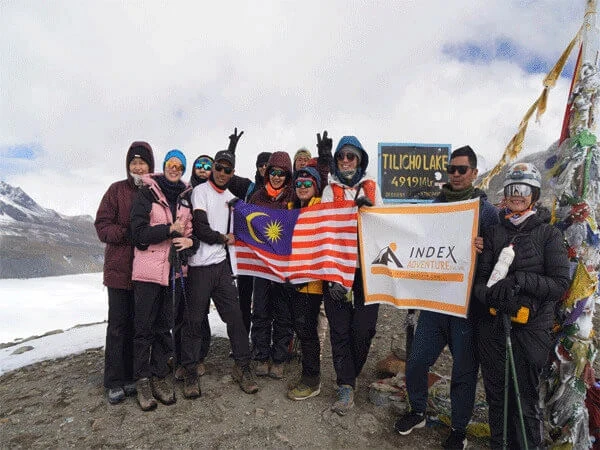
The crossing is done in a single long day from Thorong Phedi or High Camp, starting in darkness to beat the wind. At the top, prayer flags snap in the cold and a small stone marker names the altitude. On a clear morning the view stretches from the Annapurnas behind you to the Dhaulagiri range and the brown hills of Mustang ahead. Then you descend, hard and long, to Muktinath. The pass is closed by snow in deep winter and occasionally after heavy storms, which is why timing matters. For everything about the crossing, elevation profile, and how to prepare for it, read the full Thorong La Pass guide.
Permits for the Annapurna Circuit Trek
You need one mandatory permit for the Annapurna Circuit: the Annapurna Conservation Area Permit (ACAP). It costs NPR 3,000 (about USD 25) for foreign nationals, NPR 1,000 for SAARC nationals, and children under 10 go free. The permit is issued by the National Trust for Nature Conservation and is checked at multiple points along the trail, at Besisahar, Chame, Manang, and in the Jomsom area.
Here is what most websites still get wrong: the TIMS card (Trekkers' Information Management System) is no longer enforced on Annapurna trails. Under the rule changes in place since 2023, checkpoints on the circuit verify only your ACAP, and licensed agencies do not issue TIMS for this route because it is not checked in practice. What did change is the guide rule. Since 2023, solo trekking without a licensed guide or registered agency is not allowed in the Annapurna region, so you must trek with a licensed guide or a registered company. Booking a package covers this automatically.
When you book the Annapurna Circuit with Index Adventure, your ACAP is arranged for you and included in the price, so you never queue at an office or pay a permit fee at a checkpoint. Bring a passport valid for at least six months and two passport photos. For the full process and current documents, see the permit guide for the Annapurna Circuit Trek.
Accommodation and Food on the Trek
You sleep in teahouses, the family-run mountain lodges that line the entire circuit. Rooms are simple: twin beds, a shared bathroom in most places, and thin walls. The higher you go the more basic they get, and above Manang you should expect cold nights and squat toilets. A good four-season sleeping bag makes the difference between a rough night and a decent one. Private rooms and attached bathrooms are available lower down and in a few villages higher up, on request.
Food on the trail is honest mountain fare. The staple is dal bhat, lentil soup with rice and vegetables, which comes with free refills and is the smartest thing to order because it is fresh, filling, and cooked constantly. You will also find noodles, momos, fried rice, soups, eggs, and Tibetan bread, plus the occasional apple pie in the Manang bakeries. Vegetarian food is easy; the higher you go, the more sensible it is to eat vegetarian anyway, since meat is carried a long way up. Drink plenty, and treat or buy safe water rather than drinking from taps. For the full menu and what to eat where, see the guide to food and drinks during the Annapurna Circuit Trek.
Connectivity: WiFi, Mobile Signal, and Electricity
You are more connected on the Annapurna Circuit than you might expect, but not everywhere. Mobile signal, mostly Ncell and Nepal Telecom, reaches many villages up to Manang, then becomes patchy and disappears around the pass. WiFi is available in most teahouses for a small fee, and it slows and thins out the higher you climb. Electricity for charging phones and cameras is available in lodges, again for a fee at altitude, though power can cut out in bad weather.
The practical move is to carry a power bank, download your maps offline before you go, and treat the pass day as off-grid. For a full picture of what works where, see the guide to WiFi, mobile network, and electricity during the Annapurna Circuit Trek.
How to Avoid the Road Sections on the Annapurna Circuit
The most common complaint about the modern Annapurna Circuit is the roads. Vehicle tracks now run up both the Marsyangdi and Kali Gandaki valleys, and in places the old walking trail shares ground with dusty jeep road. The good news is that this is manageable, and knowing how to avoid the road is what separates a great walk from a frustrating one.
Two things solve most of it. First, the NATT trails: the New Annapurna Trekking Trails are a network of marked footpaths, painted red and white, that deliberately route walkers off the road and onto quiet paths, often on the opposite side of the valley. A guide who knows them keeps you on the good trail. Second, itinerary design: this 12-day route drives the lower valley sections that are now mostly road and puts your feet on the high central stretch from Dharapani to Muktinath, which is where the real walking lives. The Ghyaru and Ngawal high route on Day 5, for example, exists precisely to keep you above the road on a spectacular balcony path with the best views on the trek. Getting this right is exactly the kind of local knowledge a licensed guide brings, and it is why the route is built the way it is.
Annapurna Circuit Trek Compared to Other Treks
If you are still choosing your trek, the two questions people ask most are how the Annapurna Circuit compares to Annapurna Base Camp and to Everest Base Camp. The short version: the Circuit is longer, more varied, and crosses a higher pass, with more cultural and scenic change than either. Annapurna Base Camp is shorter and gets you into the heart of the mountains faster. Everest Base Camp is higher-altitude overall and more famous, but arguably less varied than the Circuit.
For a proper side-by-side, read Annapurna Circuit versus Annapurna Base Camp and Annapurna Circuit versus Everest Base Camp. If you are weighing the Circuit against Manaslu, another high-pass loop, the comparison of Manaslu Trek versus Annapurna Circuit breaks down which suits which trekker.
Alternative Annapurna Circuit Routes and Add-Ons
The 12-day route is the classic, but it is not the only way to walk the circuit. Depending on your time, budget, and appetite for wild country, there are stronger options.
- Tilicho Lake extension. Add a side trip to Tilicho Lake at around 4,900 meters, one of the highest lakes in the world, tucked under a wall of ice above the Manang valley. It adds days and altitude but rewards with one of the great sights of the region.
- Annapurna Circuit with Nar Phu Valley. Combine the circuit with the restricted Nar Phu valley, a hidden pocket of medieval Tibetan villages that few trekkers reach. This is the route for people who want the circuit plus genuine off-the-beaten-path culture.
- Classic Annapurna Circuit Trek. The longer, traditional version that walks more of the valley and adds Poon Hill and Ghorepani for the famous sunrise over the Annapurnas.
- Manaslu with Annapurna Circuit. A big-country combination for trekkers who want two high passes and the wilder Manaslu region in one trip.
Safety and Altitude Sickness
The single real risk on the Annapurna Circuit is altitude, not the trail. Above roughly 3,000 meters, going too high too fast can bring on acute mountain sickness, and above the pass the margins get thinner. This is why the itinerary is paced the way it is: a rest day at Manang, short gaining days near the top, and the "climb high, sleep low" acclimatization principle built in.
Know the early signs: headache, nausea, loss of appetite, and poor sleep. The rule that saves lives is simple: if symptoms are getting worse, you go down, and you do not cross the pass while sick. Our guides carry a first aid kit and a pulse oximeter, watch the group for symptoms, and will change the plan without hesitation if someone is struggling, because a summit is never worth a life. Comprehensive travel and rescue insurance that covers helicopter evacuation above 5,000 meters is mandatory for this trek, and you must arrange it before you arrive.
For a deeper look at prevention, symptoms, and treatment, read the guide to altitude sickness on the Annapurna Circuit Trek. And to understand the trek's safety record honestly rather than through rumor, see the facts on how many people have died on the Annapurna Circuit.
Arriving in Nepal: Visa and First Steps
Most nationalities get a Nepal tourist visa on arrival at Tribhuvan International Airport in Kathmandu. The process is straightforward: fill the form at the electronic kiosks or online beforehand, pay the fee in cash (US dollars are easiest), and you are through. A 30-day tourist visa comfortably covers this trek with time to spare on either side. Bring a passport valid for at least six months beyond your travel dates and a couple of passport photos, which you will also want for permits.
Our team meets you at the airport, and the evening before the trek we hold a briefing at our office on Amrit Marg in Thamel. We walk through the route day by day, check your gear piece by piece, and answer every question you have. If something is missing from your kit, Thamel is the best place in Asia to buy or rent trekking gear at fair prices, and we will point you to shops we trust rather than tourist traps.
Money on the Trail: Cash, ATMs, and Tipping
Carry cash, in Nepali rupees, for everything beyond the package. This is not optional advice. The last reliable ATMs are in Kathmandu and Pokhara; a machine exists in Jomsom and occasionally in Chame, but they run out of cash and go offline, and above Chame you are in a cash-only economy. Nothing on the high trail takes cards.
Budget USD 15 to 25 per day in rupees for the extras: hot showers (roughly NPR 300 to 500 at altitude), device charging (NPR 200 to 500 per device the higher you go), WiFi, tea, snacks, and the occasional beer or apple pie in Manang. Prices climb with the altitude because every bottle and every kilo of gas was carried or driven up rough roads to get there. That is not a scam; it is porters' wages built into a Snickers bar.
Tipping is customary in Nepal trekking and genuinely matters to the crews. A fair benchmark for a trek of this length is roughly USD 80 to 120 for the guide and USD 60 to 90 for the porter from the group combined, adjusted for group size and service. Hand it over at the end of the trek, ideally in an envelope, with a word of thanks. Our guides and porters are paid fair wages regardless, and the tip goes to them directly, not through the company.
Culture and Wildlife of the Annapurna Conservation Area
The circuit runs through the Annapurna Conservation Area, Nepal's largest protected area, and the walk is as much a cultural journey as a mountain one. The lower Marsyangdi valley is Gurung and Magar country, terraced and green. From Pisang upward you enter the Buddhist highlands: the villages of Ghyaru, Ngawal, and Manang are Tibetan in architecture and faith, with prayer wheels, mani walls carved with mantras, and gompas that have stood for centuries. Walk clockwise around religious monuments, ask before photographing people, and you will be welcomed everywhere. Braga's cliffside monastery, a short walk from Manang, is around 500 years old and worth an hour of anyone's rest day. Beyond the pass, Muktinath and the Kali Gandaki open into Thakali country and the old salt-trade route to Tibet.
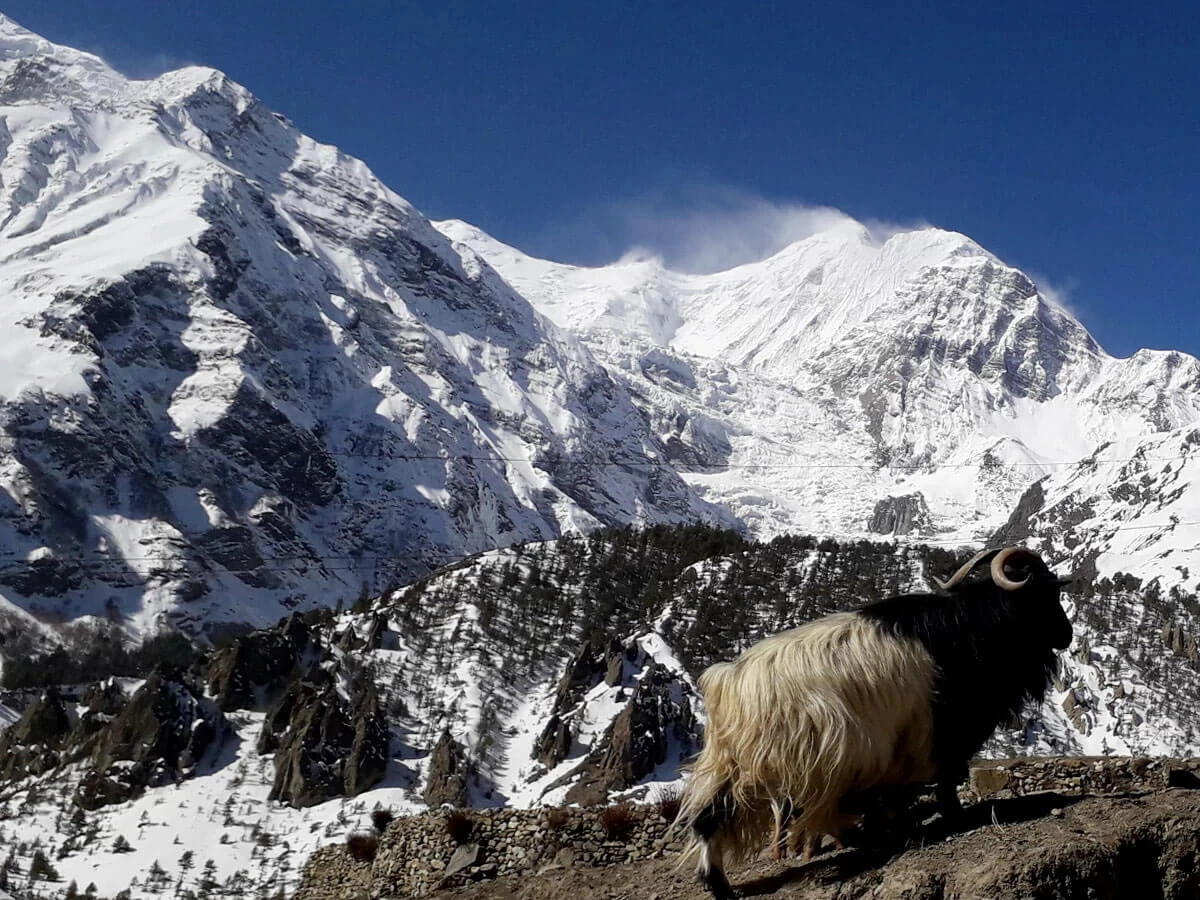
The wildlife rewards those who look up from the trail. Blue sheep graze the slopes above Yak Kharka, and where blue sheep live, snow leopards hunt, unseen by almost everyone but present. Himalayan griffons and lammergeiers ride the thermals over the upper valley. Lower down, langur monkeys crash through the forest canopy, and the birdlife runs from the danphe, Nepal's rainbow-colored national bird, to dippers working the rivers. Your ACAP permit fee funds the conservation work that keeps this intact.
Group Trek or Private Trek: Which Should You Choose?
Both work well on this route; they suit different trekkers. A group departure is the best value at USD 985, puts you with like-minded trekkers from around the world, and runs on fixed dates with guaranteed departure. The trade-off is a set itinerary and the group's pace.
A private trek costs more per person but gives you your own guide, your own dates, and the freedom to add a rest day, a side trip to Tilicho, or an extra night in Pokhara without asking anyone. Couples, families, photographers, and anyone with a fixed schedule usually go private. Solo travelers on a budget usually join a group. If you are undecided, tell us your dates and priorities and we will give you a straight recommendation, including when a group departure is genuinely the better call.
Is the Annapurna Circuit Trek Worth It?
Yes, and it is worth saying why plainly. For the effort of nine walking days and a price starting under a thousand dollars, you get the widest range of scenery of any classic trek in Nepal, a genuine high-pass crossing at 5,416 meters, living Buddhist culture rather than museum culture, and comfortable teahouses the whole way, no tents required. Trekkers who have done both the Circuit and Everest Base Camp often rate the Circuit higher for variety, even if EBC wins on fame.
The honest caveats: parts of the lower valleys carry road traffic, which is why this itinerary drives those sections and walks the NATT trails; October crowds are real at the pass; and the altitude is a serious undertaking, not a stroll. If you want solitude above all else, the Manaslu Circuit or Nar Phu may suit you better, and we run both. But as a first Himalayan trek or a lifetime highlight, the Annapurna Circuit has earned its reputation for fifty years, and the reputation still holds.
Responsible Trekking on the Annapurna Circuit
The circuit exists because local communities keep it alive, and trekking well means leaving the valley better than a bus tour would. The practical version: carry a refillable bottle and purify water instead of buying plastic bottles that have no way off the mountain; carry your trash to proper disposal points; use the safe drinking water stations where villages run them. Eat dal bhat and local food, because that money stays in the kitchen that cooked it. Buy from village shops and bakeries along the way.
We hold to responsible porter practices: fair wages paid directly, proper gear and insurance for crews, and loads within safe limits. Our guides brief every group on cultural etiquette before the trail, so nobody offends by accident in a monastery or at a mani wall. None of this costs the trekker anything. It is simply how the trek should be run, and it is part of why the villages along this route still welcome trekkers warmly after five decades.
What Our Trekkers Say
Our Annapurna Circuit departures hold a 5.0 out of 5 rating. Our travelers/client raclientsted five stars, and while our review base is still growing, the trips speak for themselves: safe pacing, guides who knew the route, and a crossing of Thorong La that people remember for the rest of their lives. Book with confidence, and add your own story to the list.