Of all the paths you take in life, make sure a few of them are dirt. — John Muir.
Every step to Everest Base Camp is a reminder that distance means nothing when the goal is everything.
Planning your Everest Base Camp trek and wondering how far you'll actually walk each day? This guide breaks down every kilometer, every elevation gain, and every section of the route so you know exactly what to expect before you hit the trail. We've guided over 500 trekkers to Everest Base Camp, and the question I hear most at the start of every trip is the same: how far is it, really? It sounds simple. But when we stood at Base Camp for the first time, we remember calculating the distance on paper felt nothing like what my legs told me above 5,000 meters.
The Everest Base Camp trek distance for a round trip from Lukla covers approximately 130 kilometers, or around 80 miles. Most trekkers complete it in 12 to 16 days, averaging 10 to 15 kilometers per day. But those numbers only tell part of the story. What makes this trek demanding isn't just the distance. It's the altitude, the Everest Base Camp trek elevation gain, and the empirical reality that your body works harder than usual with every step above 3,000 meters.
Everest Base Camp trek distance one way 65 km (40 miles)
Index Adventure has guided hundreds of trekkers through this route. From what we've seen, the people who prepare with a realistic picture of the daily distances do significantly better than those who go in expecting a straight uphill march. Here's the full breakdown, day by day, with honest notes on what each section actually involves.
How long to trek Everest Base Camp?
The standard Everest Base Camp (EBC) trek takes 12 to 14 days round-trip from Kathmandu, covering approximately 130 km (80 miles). It involves 8–9 days of trekking up to 5,364m and 3–4 days to return, with essential acclimatization days at Namche Bazaar and Dingboche. Daily walking averages 5–7 hours.
Total Everest Base Camp Trek Distance at a Glance
Quick reference before the day-by-day breakdown:
- Total round-trip distance: approximately 130 km (80 miles)
- Everest Base Camp trek distance from Lukla one way: approximately 65 km (40 miles)
- Namche Bazaar to Everest Base Camp distance: approximately 48 km (30 miles) one way
- Average daily walking distance: 10 to 15 km (6 to 9 miles)
- Total trek duration including Kathmandu stay: 12 to 16 days
- Total elevation gain from Lukla to EBC: approximately 2,500 meters
- Highest point on the trek: Kala Patthar at 5,545 meters
- Shortest day: acclimatization hike at Namche, around 3 to 4 km
- Longest day: Namche to Lukla descent on the final trekking day, around 18 to 19 km
Those numbers shift slightly depending on your specific itinerary, how many side hikes you do, and whether you fly or drive to the trailhead. But this gives you a reliable working picture.
Standard Everest Base Camp Trek Itinerary Distance
The standard 12–14 day Everest Base Camp trek covers a round-trip distance of approximately 130 km (80 miles) from Lukla. Trekkers typically walk 8–16 km (5–10 miles) daily, lasting 5–7 hours, with shorter distances (3–5 km) on acclimatization days. Key daily distances include Phakding to Namche (12 km) and Lobuche to Gorak Shep/EBC (10–15 km).
Typical Day-to-Day Distance Breakdown (Approximate):
- Day 1: Lukla to Phakding: 6–8 km (3–4 hours)
- Day 2: Phakding to Namche Bazaar: 10–12 km (5–6 hours)
- Day 3: Acclimatization in Namche: 3–7 km (3–4 hours)
- Day 4: Namche to Tengboche: 10 km (5–6 hours)
- Day 5: Tengboche to Dingboche: 10–11 km (5–6 hours)
- Day 6: Acclimatization in Dingboche: 3–4 km (2–3 hours)
- Day 7: Dingboche to Lobuche: 8–12 km (5–7 hours)
- Day 8: Lobuche to EBC to Gorak Shep: 13–15 km (7–9 hours)
- Day 9: Gorak Shep to Kala Patthar to Pheriche: 12–15 km (7–8 hours)
- Day 10-12: Trek back to Lukla: 13–16 km daily
Note: The return trek covers more distance per day as the body is accustomed to the altitude, typically walking from Pheriche or Pangboche back to Namche, and then to Lukla.
Everest Base Camp Trek Elevation Gain: What the Numbers Mean
The Everest Base Camp trek elevation gain in net terms from Lukla to Base Camp is roughly 2,500 meters. But the cumulative elevation change across the full round trip, accounting for daily ups and downs between stops, is significantly higher.
| Location | Altitude | Gain from Previous Stop |
|---|---|---|
| Lukla | 2,860m | Starting point |
| Namche Bazaar | 3,440m | +580m |
| Dingboche | 4,410m | +970m |
| Lobuche | 4,910m | +500m |
| Everest Base Camp | 5,364m | +454m |
| Kala Patthar | 5,545m | +181m from Gorak Shep |
Altitude gain above 3,000 meters affects your body differently than the same gain at lower elevations. Blood oxygen drops, breathing rate increases, and your body starts working harder just to maintain normal function. The acclimatization days at Namche and Dingboche exist specifically to manage this. Don't skip them.
Let See How long does it take to hike to Everest Base Camp in detail?
Everest Base Camp Trek Distance: Day-by-Day Breakdown
Day 1: Flight to Lukla, Trek to Phakding
Distance: 8 km (5 miles) | Duration: 3 hours | Altitude: 2,652m
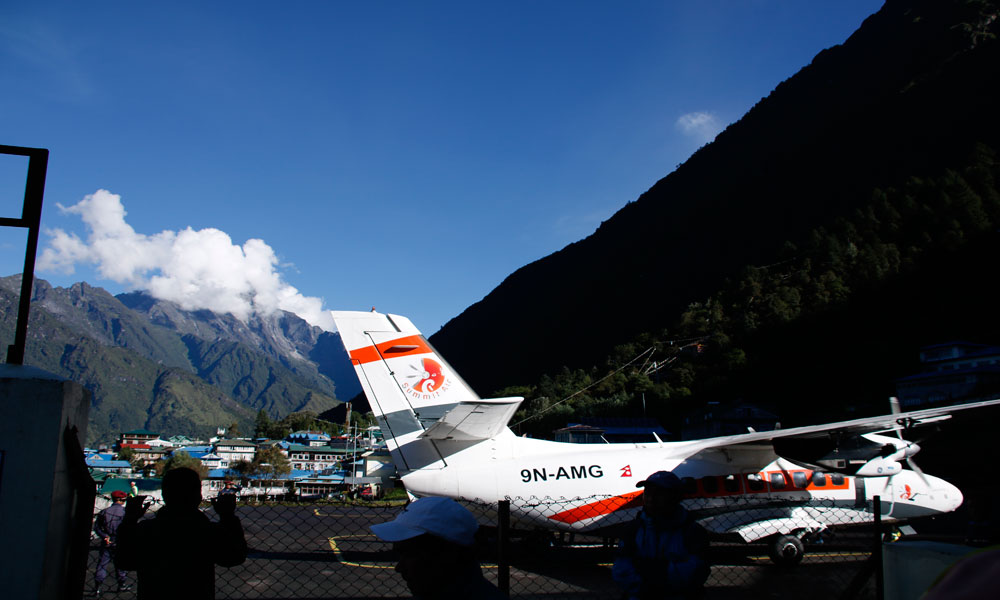
Your EBC journey starts with a short, thrilling flight into Lukla's Tenzing-Hillary Airport, one of the most dramatic runways in the world, sitting at 2,860 meters on a hillside in the Solukhumbu district. Once you land, the first day's walk to Phakding from Lukla is a relatively easy 8 kilometers taking about 3 hours.
The trail passes through Sherpa villages and places including Chaurikharka, Cheplung, Nachipang, Thado Koshigaon, Ghat, Nurning, Chhithuwa, and Dukdinma. A gentle introduction, and precisely the kind of first day that makes the rest of the trek feel achievable. Your legs will thank you for it, because the days ahead ask a lot more.
| Section | Duration | Distance | Altitude |
|---|---|---|---|
| Lukla to Chheplung | 45 min | 1.5 km | 2,660m |
| Chheplung to Ghat | 1 hr | 2.5 km | 2,530m |
| Ghat to Phakding | 1.5 to 2 hrs | 4 km | 2,610m |
Day 2: Phakding to Namche Bazaar
Distance: 10 to 12 km (6 to 7.5 miles) | Duration: 7 hours | Altitude: 3,440m
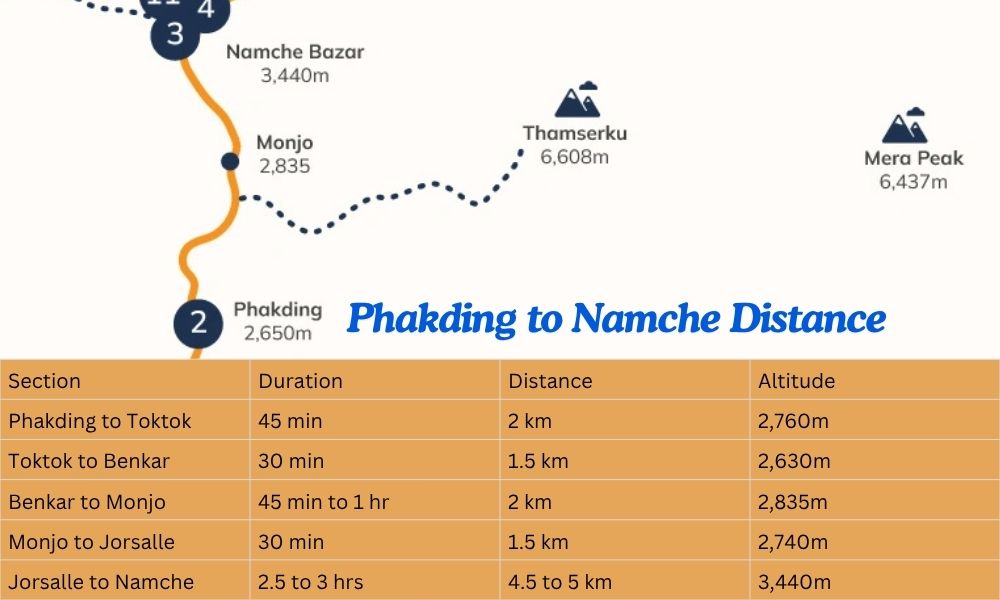
This is the day most first-timers underestimate, and you simply cannot judge a book by its cover when it comes to this section. The EBC trek distance on paper isn't extreme at 10 to 12 kilometers, but the climb into Namche Bazaar is steep and sustained.
The trail passes through Toktok, Benkar, Chumo, Jorsalle (Thumbug), and the Sagarmatha National Park checkpoint at Monjo before the final push up to Namche. Views of Kusum Kanguru, Thamserku, Everest, and Nuptse appear along the way, which helps. But your lungs are working harder than usual, and the elevation gain here is significant.
From what our guides consistently report, this is the section where trekkers most often make the mistake of pushing too hard. Slow down on the final Namche ascent. You'll feel it the next morning if you don't.
| Section | Duration | Distance | Altitude |
|---|---|---|---|
| Phakding to Toktok | 45 min | 2 km | 2,760m |
| Toktok to Benkar | 30 min | 1.5 km | 2,630m |
| Benkar to Monjo | 45 min to 1 hr | 2 km | 2,835m |
| Monjo to Jorsalle | 30 min | 1.5 km | 2,740m |
| Jorsalle to Namche Bazaar | 2.5 to 3 hrs | 4.5 to 5 km | 3,440m |
Day 3: Acclimatization at Namche Bazaar
Distance: 3 to 4 km (1.9 to 2.5 miles) | Duration: 3 to 4 hours | Altitude: up to 3,880m
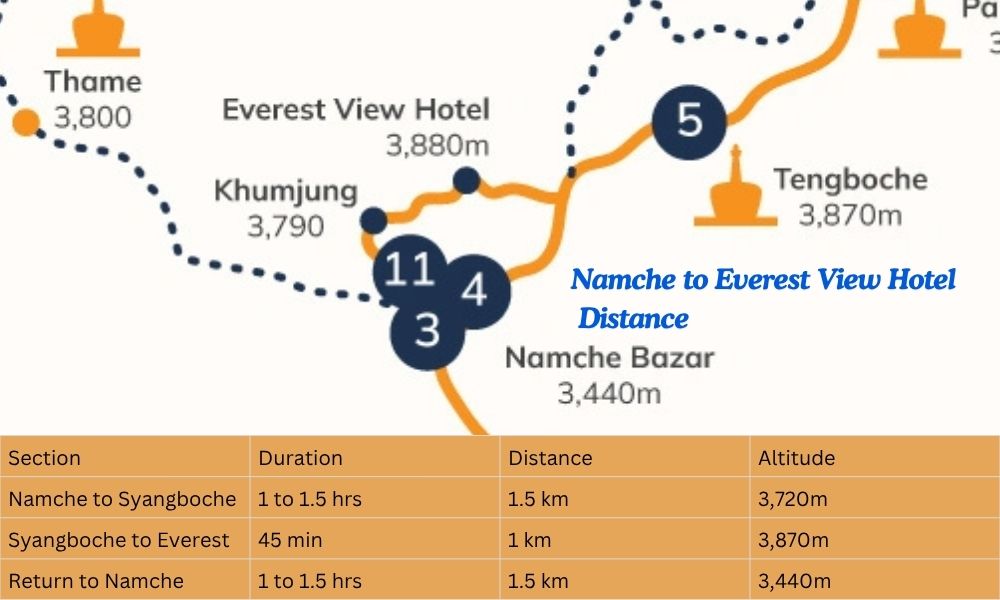
Acclimatization days aren't rest days in the passive sense. You're still walking. The standard hike goes up to Hotel Everest View at 3,880 meters, officially the world's highest hotel, for 360-degree views of Everest, Ama Dablam, Lhotse, Nuptse, and Kangtega. The round trip covers 3 to 4 kilometers and takes 3 to 4 hours. You sleep back in Namche. This is the "climb high, sleep low" principle in practice, and it genuinely works. Do not skip this day.
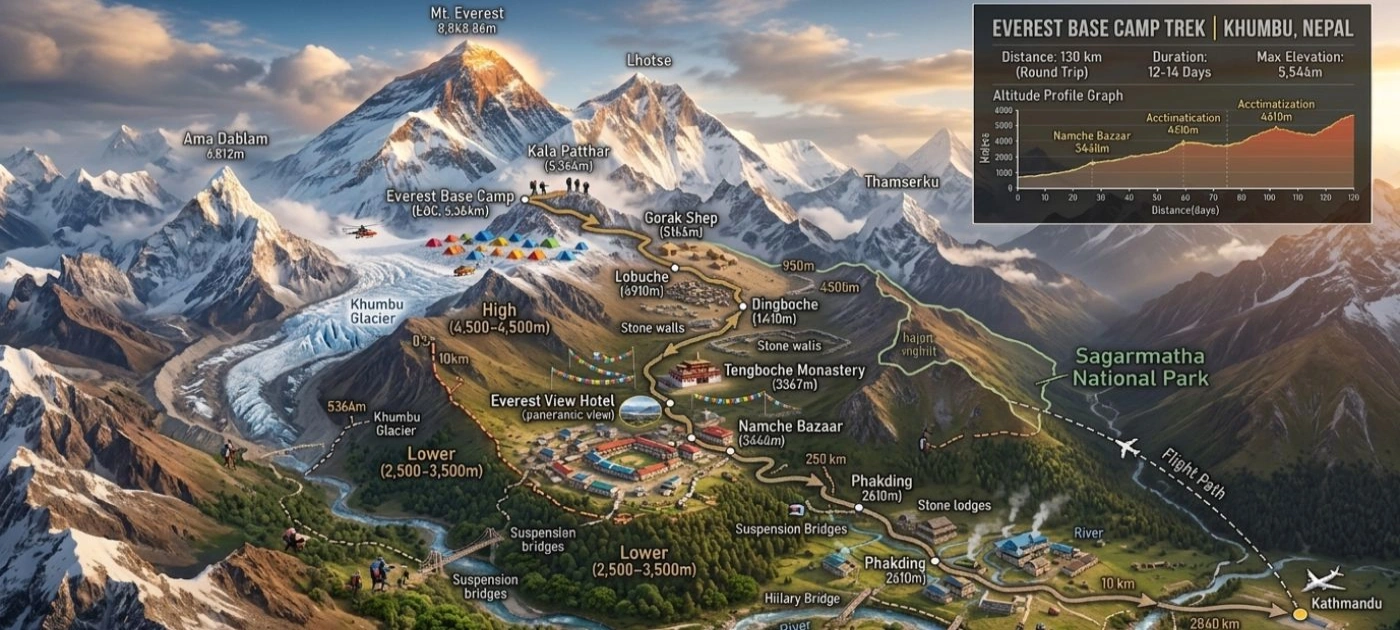
Looking at the Everest Base Camp trek map from this vantage point, you get your first real sense of how much trail still lies ahead. The Namche Bazaar to Everest Base Camp distance from this point is approximately 48 kilometers one way, and the terrain gets progressively more demanding from here. What is particularly salient at this stage is how the altitude begins to reframe your sense of distance entirely.
| Section | Duration | Distance | Altitude |
|---|---|---|---|
| Namche to Syangboche Airstrip | 1 to 1.5 hrs | 1.5 km | 3,720m |
| Syangboche to Everest View Hotel | 45 min | 1 km | 3,880m |
| Return to Namche | 1 to 1.5 hrs | 1.5 km | 3,440m |
Day 4: Namche Bazaar to Tengboche
Distance: 10 to 11 km (6 to 6.8 miles) | Duration: 5 hours | Altitude: 3,860m
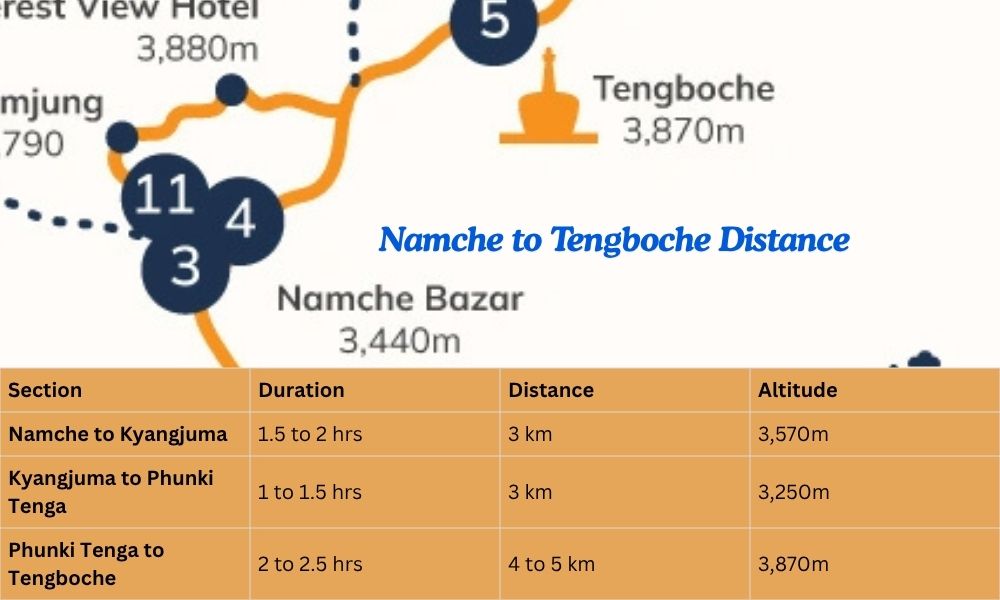
Refreshed from your rest day, the trail from Namche climbs gently toward Kyangjuma and Chhatyang Kharka through pine forests and past mani walls, then drops down to Phunki Tenga before a continuous uphill push to Tengboche.
The monastery here is the largest in the Khumbu region and one of the most striking cultural landmarks on the entire route. The distance is manageable at 10 to 11 kilometers, and the 5-hour walking time feels fair given the scenery.
| Section | Duration | Distance | Altitude |
|---|---|---|---|
| Namche to Kyangjuma | 1.5 to 2 hrs | 3 km | 3,570m |
| Kyangjuma to Phunki Tenga | 1 to 1.5 hrs | 3 km | 3,250m |
| Phunki Tenga to Tengboche | 2 to 2.5 hrs | 4 to 5 km | 3,860m |
Day 5: Tengboche to Dingboche
Distance: 11 to 12 km (6.8 to 7.5 miles) | Duration: 5 hours | Altitude: 4,410m
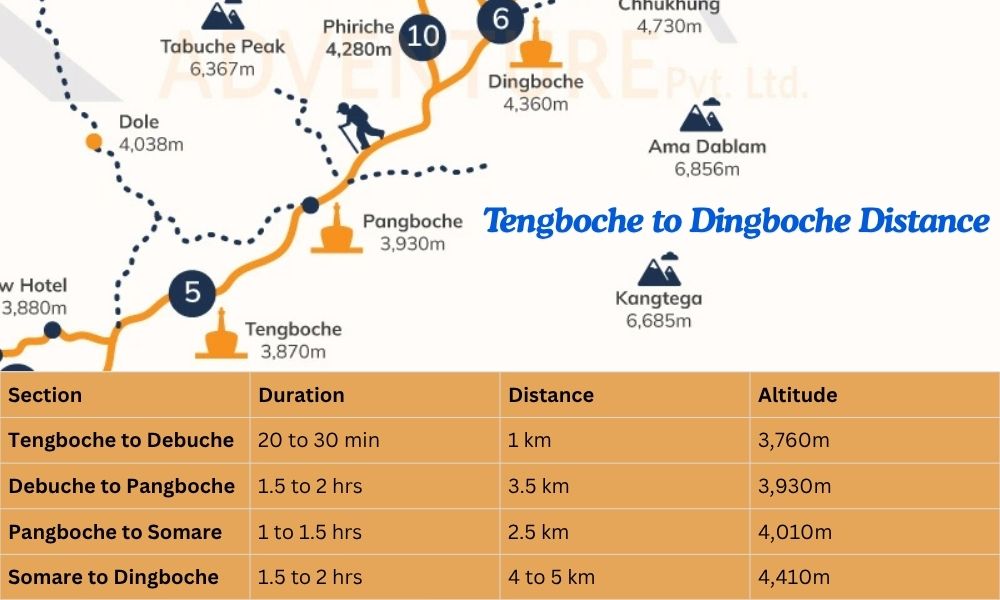
The trail descends briefly from Tengboche to Debuche, crosses the Imja Khola, and climbs gradually toward Deboche and then Pangboche, one of the oldest Sherpa villages in the Khumbu. From there, open meadows lead through Somare and Orsho before the steady uphill finish into Dingboche at 4,410 meters. Dingboche is the highest permanent Sherpa settlement in this section of the route.
Stay well hydrated from here onwards. The altitude and cumulative Everest Base Camp trek elevation gain start to bite properly above 4,000 meters, and trekkers who underestimate this transition are the ones who struggle most in the days ahead.
| Section | Duration | Distance | Altitude |
|---|---|---|---|
| Tengboche to Debuche | 20 to 30 min | 1 km | 3,760m |
| Debuche to Pangboche | 1.5 to 2 hrs | 3.5 km | 3,930m |
| Pangboche to Somare | 1 to 1.5 hrs | 2.5 km | 4,010m |
| Somare to Dingboche | 1.5 to 2 hrs | 4 to 5 km | 4,410m |
Day 6: Acclimatization at Dingboche
Distance: 5 to 6 km (3.1 to 3.7 miles) | Duration: 4 to 5 hours | Altitude: up to 5,083m
Your second dedicated acclimatization day. The hike up to Nangkartshang Peak at 5,083 meters is a short but sharp climb that rewards you with outstanding views of Makalu, Ama Dablam, Chhopulu, Lhotse Shar, Island Peak, Nuptse, Lobuche, and Cholatse. It's also genuinely useful preparation for the higher altitude you'll face in the days ahead. The round trip covers 5 to 6 kilometers in 4 to 5 hours, then you return to sleep at Dingboche.
Index Adventure guides use pulse oximeters on this day to check blood oxygen saturation levels. If your readings have dropped significantly from the previous day, your guide may recommend an additional rest day before pushing higher. That's not a failure. That's the right call.
| Section | Duration | Distance | Altitude |
|---|---|---|---|
| Dingboche to Nangkartshang Peak | 2 to 2.5 hrs | 2.5 to 3 km | 5,083m |
| Nangkartshang Peak to Dingboche | 1.5 to 2 hrs | 2.5 to 3 km | 4,410m |
Day 7: Dingboche to Lobuche
Distance: 11 to 12 km (6.8 to 7.5 miles) | Duration: 5 hours | Altitude: 4,910m
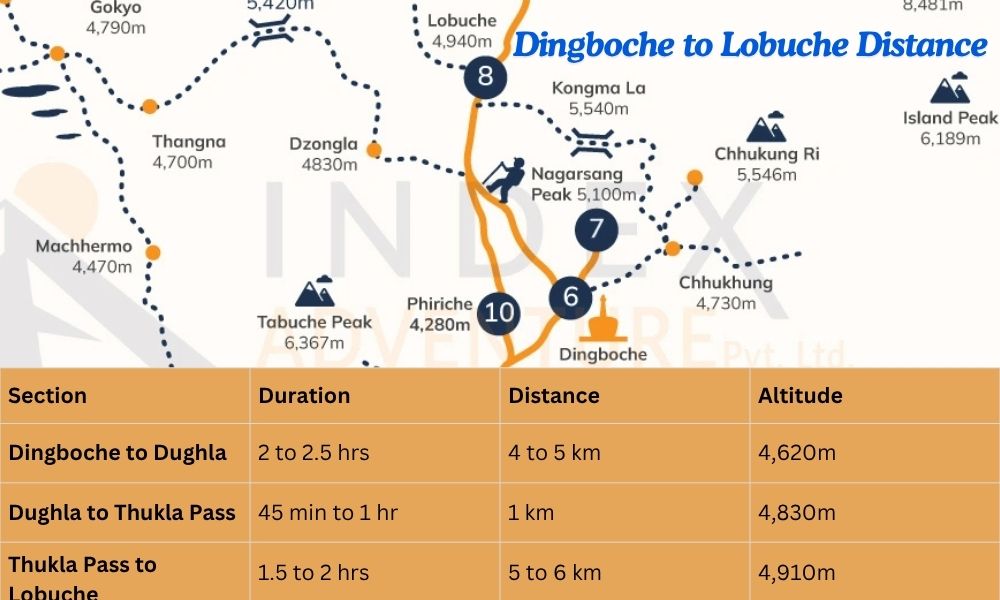
The landscape changes noticeably on this section. The green, forested lower trail gives way to barren valleys and glacial moraine as you move deeper into the high Khumbu. The ascent to parlung Kharka and Thukla Pass at 4,830 meters is demanding and emotionally charged.
Stone memorials line the ridge, honoring climbers who didn't come home from Everest. It's a moment that tends to stop people in their tracks. From the pass, the trail continues to Lobuche at 4,910 meters, with peaks like Taboche and Nuptse framing the horizon.
| Section | Duration | Distance | Altitude |
|---|---|---|---|
| Dingboche to Dughla | 2 to 2.5 hrs | 4 to 5 km | 4,620m |
| Dughla to Thukla Pass | 45 min to 1 hr | 1 km | 4,830m |
| Thukla Pass to Lobuche | 1.5 to 2 hrs | 5 to 6 km | 4,910m |
Day 8: Lobuche to Gorak Shep to Everest Base Camp and Back
Distance: 14 to 15 km (8.7 to 9.3 miles) | Duration: 8 hours | Altitude: 5,364m
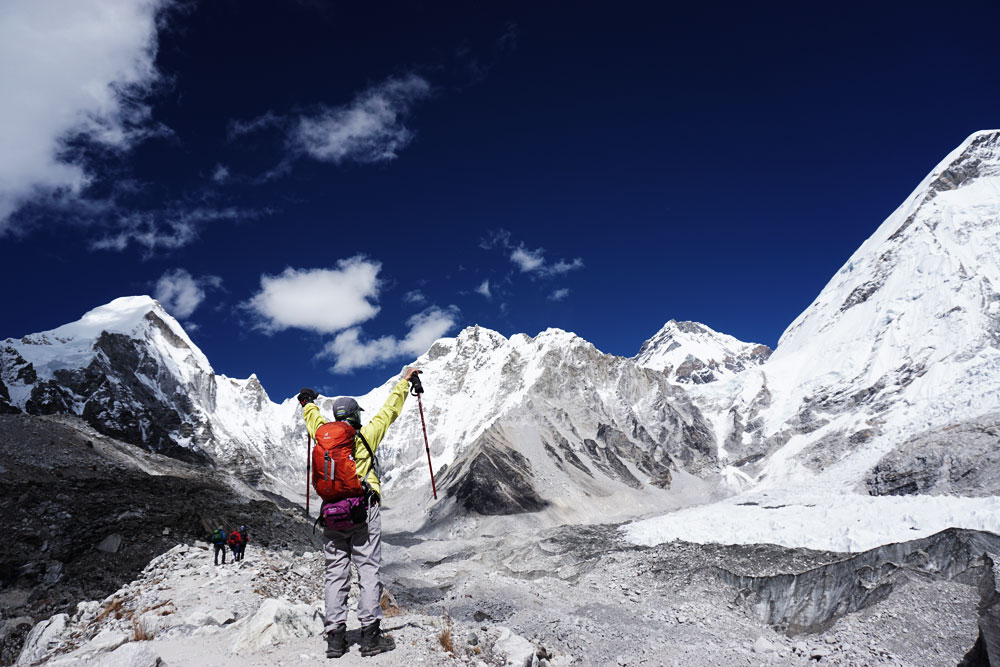
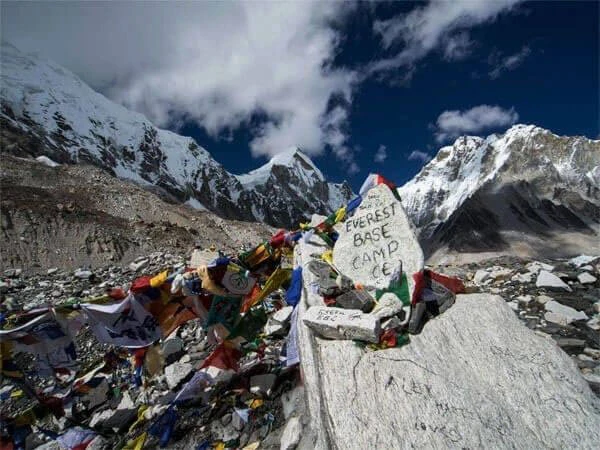
This is the day. The one you came for. From Lobuche, the trail climbs gently over 4.5 kilometers to Gorak Shep at 5,164 meters, the last settlement before Base Camp. After a light lunch, you push on another 4 to 4.5 kilometers each way to Everest Base Camp at 5,364 meters. The round trip to EBC from Gorak Shep covers 8 to 9 kilometers and takes 4 to 5 hours. You're walking across glacial moraine, past the Khumbu Icefall, with Nuptse, Lhotse, and Everest visible above. Return to Gorak Shep to sleep.
Trekkers who have never been above 5,000 meters often describe the Base Camp arrival as genuinely overwhelming, not just physically but in terms of what it means to actually be standing there. That's worth knowing before you go, because no amount of preparation fully prepares you for the moment you hit the ground running and arrive at one of the most iconic destinations on earth.
| Section | Duration | Distance | Altitude |
|---|---|---|---|
| Lobuche to Gorak Shep | 2 to 2.5 hrs | 4.5 km | 5,164m |
| Gorak Shep to EBC and return | 4 to 5 hrs | 8 to 9 km | 5,364m |
Day 9: Gorak Shep to Kala Patthar, then Trek to Pheriche
Distance: 13 to 14 km (8 to 8.7 miles) | Duration: 7 hours | Altitude: 5,545m at peak
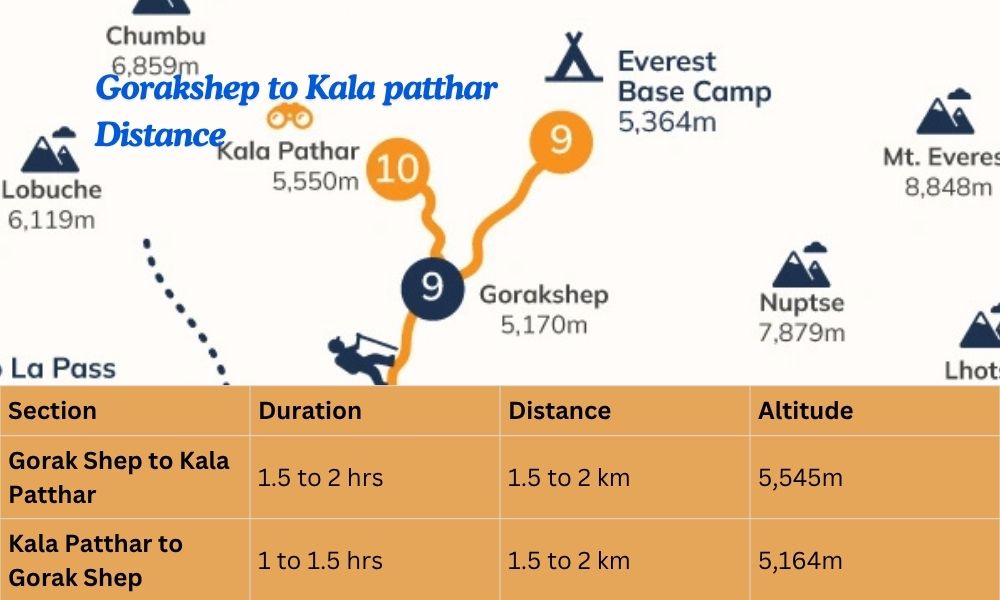
You wake up before dawn for the ascent to Kala Patthar at 5,545 meters, the highest point of the trek and the best sunrise viewpoint for Everest. The climb from Gorak Shep covers about 1.5 to 2 kilometers each way and takes 1.5 to 2 hours up. It's steep, cold, and dark when you start. It's worth every step when the light hits the summit. After breakfast back at Gorak Shep, the long descent to Pheriche covers 10 to 11 kilometers through rugged ridges and glacial valleys.
| Section | Duration | Distance | Altitude |
|---|---|---|---|
| Gorak Shep to Kala Patthar | 1.5 to 2 hrs | 1.5 to 2 km | 5,545m |
| Kala Patthar to Gorak Shep | 1 to 1.5 hrs | 1.5 to 2 km | 5,164m |
| Gorak Shep to Lobuche | 1.5 to 2 hrs | 4.5 km | 4,910m |
| Lobuche to Pheriche | 2 to 2.5 hrs | 5.5 to 6 km | 4,210m |
Day 10: Pheriche to Namche Bazaar
Distance: 14 to 15 km (8.7 to 9.3 miles) | Duration: 7 hours | Altitude: 3,440m
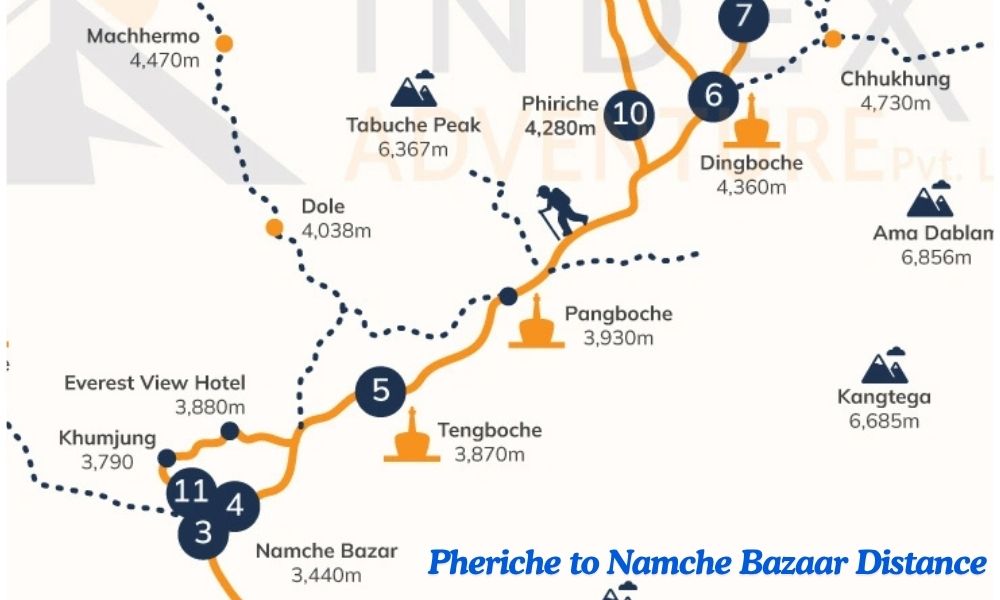
A long descent retracing the outward route, passing Pangboche, Debuche, Tengboche, Phunki Tenga, and Kyangjuma before arriving back in Namche Bazaar. The distance of 14 to 15 kilometers takes about 7 hours. Going downhill feels easier on the lungs but harder on the knees, so trekking poles earn their keep on this day. The nuanced physical challenge of the descent is something most trekkers don't anticipate until they're knee-deep in it. The Namche Bazaar to Everest Base Camp distance you covered on the way up suddenly feels very real when you're walking it backwards.
| Section | Duration | Distance | Altitude |
|---|---|---|---|
| Pheriche to Pangboche | 1.5 to 2 hrs | 4 km | 3,930m |
| Pangboche to Tengboche | 1 to 1.5 hrs | 3 km | 3,860m |
| Tengboche to Phunki Tenga | 45 min to 1 hr | 2.5 km | 3,250m |
| Phunki Tenga to Kyangjuma | 1 to 1.5 hrs | 3 km | 3,570m |
| Kyangjuma to Namche | 45 min to 1 hr | 2.5 km | 3,440m |
Day 11: Namche Bazaar to Lukla
Distance: 18 to 19 km (11 to 11.8 miles) | Duration: 7 hours | Altitude: 2,860m
The longest single-day distance on the entire trek. 18 to 19 kilometers from Namche back to Lukla through Jorsalle, Monjo, Phakding, and Choplung. It takes about 7 hours and covers familiar ground you walked on day two, except now everything feels different because you know what you've done. Your legs know too. By the time you reach Lukla and sit down for the evening, the whole journey tends to hit properly.
Total EBC Trek Distance Summary Table
| Day | Route | Distance | Duration | End Altitude |
|---|---|---|---|---|
| 1 | Lukla to Phakding | 8 km | 3 hrs | 2,652m |
| 2 | Phakding to Namche | 10 to 12 km | 7 hrs | 3,440m |
| 3 | Namche Acclimatization | 3 to 4 km | 3 to 4 hrs | 3,880m |
| 4 | Namche to Tengboche | 10 to 11 km | 5 hrs | 3,860m |
| 5 | Tengboche to Dingboche | 11 to 12 km | 5 hrs | 4,410m |
| 6 | Dingboche Acclimatization | 5 to 6 km | 4 to 5 hrs | 5,083m |
| 7 | Dingboche to Lobuche | 11 to 12 km | 5 hrs | 4,910m |
| 8 | Lobuche to EBC and back to Gorak Shep | 14 to 15 km | 8 hrs | 5,364m |
| 9 | Kala Patthar and down to Pheriche | 13 to 14 km | 7 hrs | 4,210m |
| 10 | Pheriche to Namche | 14 to 15 km | 7 hrs | 3,440m |
| 11 | Namche to Lukla | 18 to 19 km | 7 hrs | 2,860m |
| Total | ~123 km (76 miles) | ~60 hrs walking |
Everest Base Camp Trek Distance From Different Starting Points
Everest Base Camp Trek Distance From Lukla
The standard Everest Base Camp trek distance from Lukla is approximately 65 kilometers one way, or 130 kilometers round trip. This is the figure most itineraries reference and the most accurate baseline for planning.
Namche Bazaar to Everest Base Camp Distance
The Namche Bazaar to Everest Base Camp distance runs approximately 48 kilometers one way, covering the most altitude-demanding section of the entire route.
From Kathmandu by Road
For trekkers who want to avoid the Lukla flight entirely, the overland route adds significant total distance. Full breakdown: Kathmandu to Phaplu by jeep covers 267 km, Phaplu to Surke by road adds another 70 km, Surke joining the standard EBC trail to Base Camp and back is approximately 120 km, and the return drive from Surke to Kathmandu runs 337 km.
Total combined road and trek distance comes to approximately 790 to 800 kilometers over 17 days. Index Adventure runs this itinerary specifically for trekkers who want a deeper, more immersive connection to the Khumbu region without the Lukla flight.
Base Camp to Everest Summit: How Far and How Long?
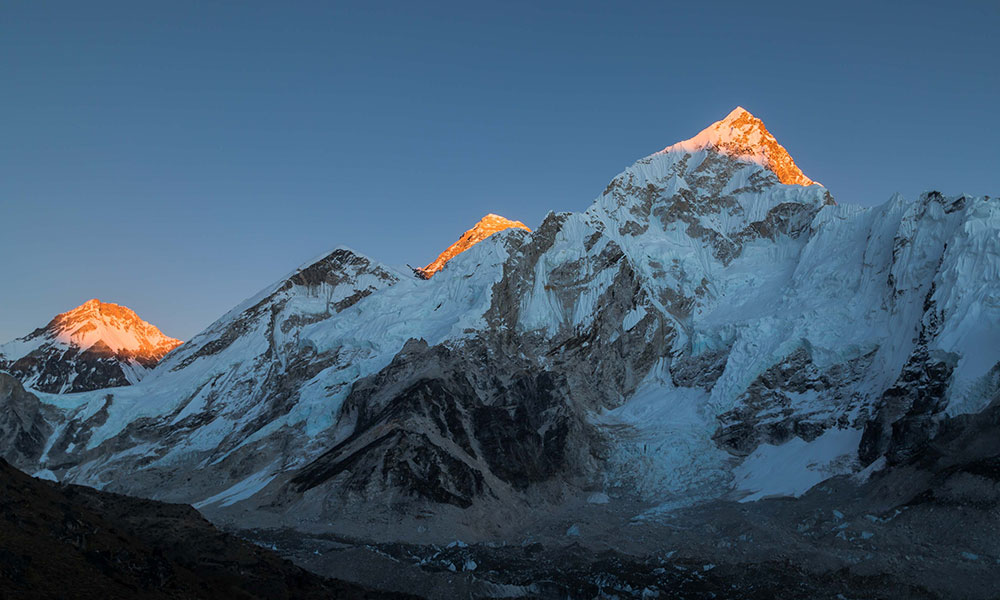
A question that comes up regularly is about Base Camp to Everest summit time and distance, and it's worth addressing clearly because there's a meaningful difference between trekking to Base Camp and actually climbing Everest.
From Base Camp at 5,364 meters to the summit at 8,849 meters, the vertical gain is approximately 3,485 meters. The one-way distance across the climbing route is roughly 8 to 9 kilometers. But that number means almost nothing in isolation.
Professional climbers typically spend 6 to 8 weeks on the mountain, making multiple rotations between Base Camp and higher camps before the final summit push. The summit attempt from Camp IV at around 8,000 meters takes 12 to 18 hours one way depending on conditions.
The EBC trek takes you to the base of the mountain, not up it. What you see from Base Camp and Kala Patthar is the beginning of the climbing route. The Everest Base Camp trek distance and the Everest summit route are two entirely different undertakings requiring completely different levels of preparation and technical skill.
Distance Comparison Across Everest Region Trek Packages
| Trek Package | Walking Distance | Best For |
|---|---|---|
| EBC with Helicopter Return | 65 km (40 miles) | Limited time trekkers |
| Everest Panorama Trek | 55 to 65 km (34 to 40 miles) | First-time high altitude |
| Standard EBC Round Trip | 120 to 130 km (75 to 81 miles) | Most trekkers |
| EBC with Cho La Pass | 130 to 140 km (81 to 87 miles) | Experienced trekkers |
| Everest Gokyo Lake Trek | 92 to 110 km (57 to 68 miles) | Scenic alternative |
| Everest Gokyo and Renjo La | 110 to 130 km (68 to 81 miles) | Extended explorers |
| Everest High Passes Trek | 170 to 180 km (105 to 112 miles) | Advanced trekkers |
What the Distance Doesn't Tell You
The kilometer count is the least useful way to think about this trek, and trekkers who fixate on it are the ones who most often find themselves caught off guard. Ten kilometers at 5,000 meters above sea level feels nothing like ten kilometers on a flat path at home. Your breathing is heavier, your pace is slower, your body is managing altitude stress on top of physical effort. A day that covers 11 kilometers at high altitude can leave you more drained than a 25-kilometer day at sea level.
The Everest Base Camp trek elevation gain across the full route is what actually defines the physical challenge, not the horizontal distance. Combined with thin air above 4,000 meters, even short distances feel disproportionately hard.
The two things that actually determine how manageable each day feels are pacing and acclimatization. Go slower than you think you need to. The Nepali phrase "bistarai bistarai" means slowly, slowly, and the guides say it constantly because it works. The acclimatization days aren't optional padding. They're necessary infrastructure for reaching Base Camp safely. Learn more about the difficulty of Everest Base Camp Trek.
Index Adventure builds all itineraries with proper rest days and sensible daily distances. The goal is never to cover ground as fast as possible. It's to get you to Base Camp and back safely while making sure you actually enjoy the process rather than just endure it.
Altitude Sickness Warning: Read This Before You Trek
This section contains safety-critical information. Ignoring altitude sickness symptoms can be life-threatening. Always consult a medical professional before your trek.
Acute Mountain Sickness (AMS) can affect any trekker above 2,500 meters, regardless of fitness level. Symptoms include headache, nausea, dizziness, fatigue, and loss of appetite. These are warning signals your body sends for a reason. The two serious forms are High Altitude Cerebral Edema (HACE) and High Altitude Pulmonary Edema (HAPE). Both are medical emergencies that can be fatal without immediate treatment.
HACE symptoms: severe headache, loss of coordination, confusion, hallucinations.
HAPE symptoms: breathlessness at rest, persistent cough, pink or frothy sputum, extreme fatigue.
The golden rules of altitude safety:
- Never ascend with AMS symptoms. Acclimatize or descend.
- Descend immediately if symptoms worsen or HACE or HAPE is suspected. Descent is the treatment.
- Drink 3 to 4 liters of water daily. Avoid alcohol and sleeping pills above 3,500 meters.
- Tell your guide immediately if you feel unwell, even mildly.
- Do not leave Namche or Dingboche on acclimatization days to push higher.
Index Adventure guides carry pulse oximeters and hold wilderness first response training, but they are not a substitute for professional medical care. For detailed clinical guidance, refer to the Wilderness Medical Society altitude illness guidelines and the CIWEC Clinic in Kathmandu, which specializes in altitude medicine.
Travel insurance requirement: All trekkers booking with Index Adventure must carry travel insurance that includes helicopter evacuation coverage up to 6,000 meters. A helicopter rescue from EBC altitude can cost USD 3,000 to 7,000 without coverage. This is not optional. It's your emergency safety net.
Practical Tips for Managing the EBC Trek Distance
Before you go: train on hilly terrain carrying a loaded backpack rather than just flat cardio, build up to walking 6 to 8 consecutive hours before your departure date, focus on leg strength and cardiovascular fitness for at least 2 to 3 months in advance, get a pre-trek medical check if you have any cardiovascular or respiratory conditions, and study the Everest Base Camp trek map to understand which sections carry the steepest elevation gain.
On the trail: use trekking poles especially for the long descents on days 9, 10, and 11, drink 3 to 4 liters of water daily regardless of whether you feel thirsty, eat properly even when altitude suppresses your appetite because your body needs the fuel, and tell your guide immediately if you feel unwell, even mildly.
On pacing and timing: don't compare your pace to other trekkers on the trail, slower and steady genuinely beats faster and struggling at altitude every time, build buffer days into your itinerary so weather or health doesn't derail the whole trip, and remember that the descent days are longer in distance but easier on the lungs. Watch your knees.
Frequently Asked Questions About EBC Trek Distance
How many km is the Everest Base Camp trek per day on average?
On a standard 12 to 14-day itinerary, you'll walk 10 to 15 km per day on active trekking days, with shorter acclimatization hikes of 3 to 6 km on rest days. The longest single day is the final Namche to Lukla descent at 18 to 19 km.
Is the EBC trek harder on the way up or the way down?
The ascent is harder on your lungs. Every step above 3,000 meters requires more effort as oxygen levels drop. The descent is harder on your knees and ankles because of sustained downhill gradient over long distances. Trekking poles make a significant difference on the return journey.
Can I do the EBC trek without a guide?
Solo trekking is permitted in the Khumbu region unlike some restricted areas of Nepal. However, Index Adventure strongly recommends hiring a licensed guide. A trained guide can recognize altitude sickness symptoms early, knows evacuation protocols, and has established relationships with teahouse owners along the route. This is a safety-critical recommendation, not just a commercial one.
What permits do I need for the EBC trek in 2026?
You'll need a Khumbu Pasang Lhamu Rural Municipality Entry Permit and a Sagarmatha National Park entry permit. Permit fees are reviewed seasonally by the Nepalese government. Confirm current rates with Index Adventure or the Nepal Tourism Board before booking.
How fit do I need to be for the EBC trek?
You don't need to be an athlete, but you should be capable of walking 6 to 8 hours with a day pack on consecutive days. Prior experience trekking at altitude is a significant advantage. If you've never been above 3,000 meters before, start your acclimatization planning early and discuss your fitness history with our team before booking.
What is the best time to do the EBC trek?
The two main seasons are pre-monsoon spring (March to May) and post-monsoon autumn (October to November). October and November offer the most stable weather and clearest views.
What You'll See Along the Distance
The distance itself is just the frame. What fills it in is harder to quantify.
Walking the lower sections through rhododendron forest, past mani walls and prayer flags, with the sound of the Dudh Koshi River somewhere below. Passing through Namche Bazaar and realizing it's a proper, lively town sitting at over 3,400 meters. Standing at the Thukla Pass memorials and feeling the weight of Everest's history in a way that no documentary quite prepares you for. And then, finally, walking across the moraine to Base Camp itself, where the Khumbu Icefall rises above you and the whole journey suddenly makes complete sense.
The total Everest Base Camp trek distance is approximately 130 kilometers. The EBC trek distance from Lukla alone is 65 kilometers one way. The Namche Bazaar to Everest Base Camp distance covers 48 kilometers of the most dramatic mountain terrain on earth. But from what we've seen guiding over 200 trekkers through this route, every single one of those kilometers gives you something back. That's not a small thing.
Key Takeaways
- The total EBC round-trip trek distance from Lukla is approximately 130 km, averaging 10 to 15 km per day across 12 to 16 days.
- The elevation gain, not the horizontal distance, is what defines the physical challenge above 4,000 meters.
- Acclimatization days at Namche Bazaar and Dingboche are non-negotiable and directly affect your ability to reach Base Camp safely.
- Altitude sickness is the most salient safety risk on this route. Knowing the symptoms of AMS, HACE, and HAPE before you trek is essential.
- Hiring a licensed guide, carrying travel insurance with helicopter evacuation coverage, and pacing slowly are the three most empirically important decisions you'll make before booking.
How far is base camp to Camp 1?
The distance from Everest Base Camp (approx. 5346m) to Camp 1 (approx. 6065m) is roughly 6.4 km (4 miles). This climb takes roughly 4 to 6 hours for experienced climbers, though it can take 10-12 hours for others, as it involves navigating the dangerous Khumbu Icefall.
Can I do Everest Base Camp in 10 days?
Yes, you can complete the Everest Base Camp (EBC) trek in 10 days, but it is considered a fast-paced, strenuous itinerary designed for fit, experienced trekkers. This short route typically removes dedicated acclimatization rest days, requiring high physical fitness and excellent cardiovascular health to manage risks of altitude sickness.
Can you do Everest Base Camp in 7 days?
A 7-day Everest Base Camp (EBC) trek is a high-speed, challenging itinerary utilizing helicopter returns to save time. It requires excellent fitness to ascend to over 5,300m in just a few days. The route typically includes Lukla flight, Namche acclimatization, Tengboche Monastery, EBC, and a helicopter flight back to Kathmandu.
Ready to stop sitting on the fence and book your Everest Base Camp trek? Reach out to the Index Adventure team directly. We'll match you to the right itinerary based on your fitness, timeframe, and experience level, and make sure you hit the ground running with everything you need to get there and back safely.