Bhoto Jatra is not your average festival. Most festivals celebrate something that happened. This one is still waiting for something to happen.
Bhoto Jatra 2026: Date, Story, History, Time and Everything You Need to Know
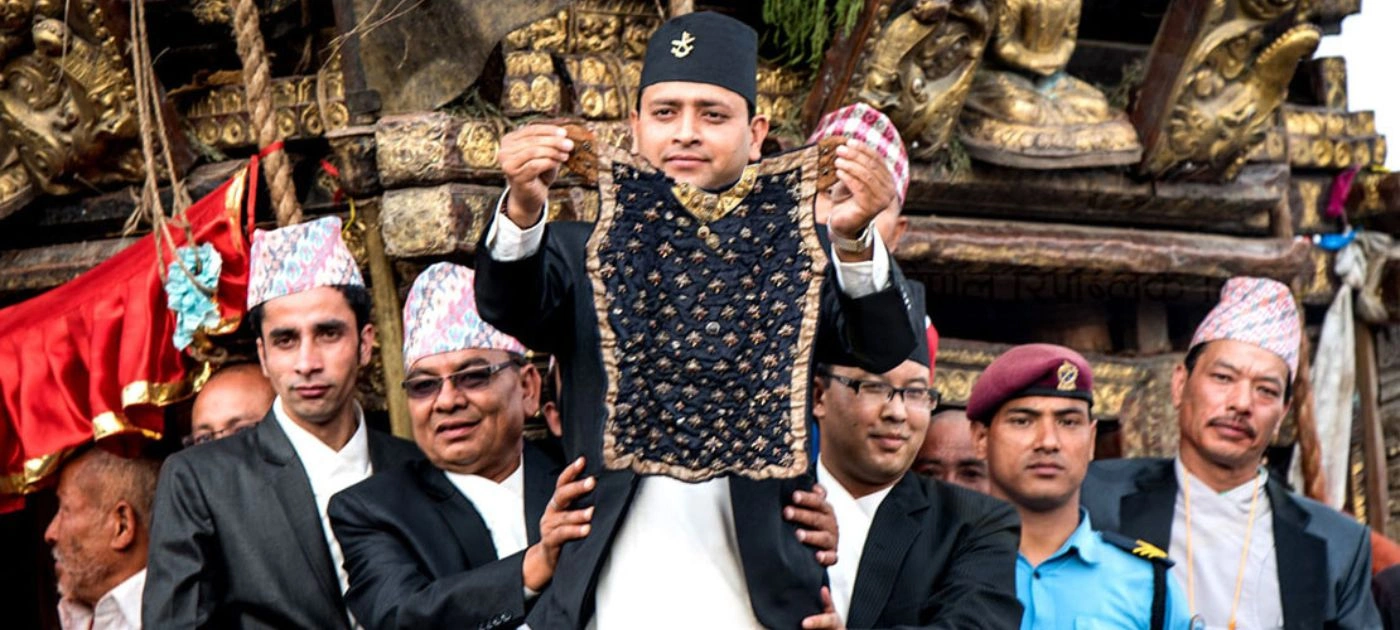
Every single year, somewhere in the open grounds of Jawalakhel, Lalitpur, in the heart of Kathmandu Valley, a senior government official climbs onto the towering Rato Machhindranath chariot and holds up a jewel-studded vest. He turns it north, south, east, and west. He faces it to the sky and to the crowd. And then he asks, in the oldest possible way a question can be asked, whether anyone can prove the vest belongs to them.
No one has answered yet.
That unanswered question, preserved with the full weight of the Newar cultural tradition, the Guthi system, and the authority of the state, is what makes Bhoto Jatra one of the most extraordinary living festivals not just in Nepal, but anywhere in the world. It is not a reenactment of a myth. It is a myth still in progress, performed live once a year, with the president of Nepal in attendance.
This is the complete guide to Bhoto Jatra 2026, covering the date, time, public holiday status, the full mythological story, the history behind the festival, the route through Patan, the ceremony details, and everything else you need to know before the vest is shown again.
What Is Bhoto Jatra? Meaning and Definition
Bhoto Jatra, also written as Bhotojatra, translates directly to the Festival of the Vest in English. "Bhoto" means vest or waistcoat in Nepali. "Jatra" means festival or procession. Bhoto Jatra, therefore, means the festival where the vest is shown, which is also why it is called Bhoto Dekhaune Jatra in local Newari usage, meaning the vest-showing festival.
It is the grand finale and the most sacred ritual of the Rato Machhindranath Jatra, the month-long chariot procession celebrated in Patan (Lalitpur), Kathmandu Valley. The festival is observed as a public holiday across the Kathmandu Valley and is attended by the President of Nepal, senior government officials, the Living Goddess Kumari of Patan, and tens of thousands of devotees from across the country and abroad.
In Nepali, Bhoto Jatra is sometimes also referred to as the Bhoto Dekhaune Jatra. For anyone writing an essay on Bhoto Jatra, or looking to explain Bhoto Jatra in English or Nepali, this is the core definition to begin with.
Bhoto Jatra 2026 Date, Time and Public Holiday Status
The Bhoto Jatra 2026 date has not been officially confirmed yet. The date is never fixed in advance. It is determined annually by astrological calculations and depends on the exact day the Rato Machhindranath Rath (chariot) reaches the open grounds at Jawalakhel in Lalitpur. The ceremony is held a few days after the chariot arrives.
Based on historical patterns, Bhoto Jatra 2026 (2083 B.S.) is expected in late May to early June 2026, during the Jestha month of the Bikram Sambat calendar.
For Bhoto Jatra time, the ceremony typically begins in the late afternoon, usually around 3 PM to 5 PM, and lasts approximately 2 to 3 hours, including the ceremonial procession, cultural performances, and the actual vest-showing ritual.
Bhoto Jatra Date History: Year by Year
|
Year (A.D.) |
Year (B.S.) |
Date |
Day |
Notes |
|
2026 |
2083 |
TBC (Late May / Early June) |
TBC |
Official date pending chariot arrival |
|
2025 |
2082 |
June 1, 2025 |
Sunday |
Jestha 18, 2082 |
|
2024 |
2081 |
August 4, 2024 |
Sunday |
Delayed due to chariot complications |
|
2023 |
2080 |
Approx. May / June 2023 |
— |
Based on lunar calendar |
Bhoto Jatra Public Holiday: Is It a Holiday in Nepal?
Yes, Bhoto Jatra is a public holiday, but only within the Kathmandu Valley. Lalitpur, Kathmandu, and Bhaktapur districts officially observe the holiday. Government offices, banks, schools, and many businesses in the valley remain closed on Bhoto Jatra day.
It is not a nationwide public holiday across all of Nepal. If you are outside the Kathmandu Valley, offices and schools generally remain open.
For 2025, the Bhoto Jatra public holiday in Kathmandu Valley fell on June 1, a Sunday, which meant the holiday was observed formally but did not add an additional weekday off for most.
Is there a holiday on Bhoto Jatra? Yes, always, within the valley. Is today Bhoto Jatra 2026? Check the official announcements from the Bhoto Jatra organizing committee and local government offices as the Jestha month approaches.
Bhoto Jatra History: Who Started It and Where It Comes From
To understand the history of Bhoto Jatra, you have to go back to the reign of King Guna Kamadev, the historical king of Kathmandu Valley credited with organizing and institutionalizing many of the Newar traditions that survive to this day. It was under his authority that the original dispute over the bhoto was heard and the ruling was made that the vest should remain in the custody of the rain deity Rato Machhindranath until the rightful owner came forward with undeniable proof.
The festival has been observed continuously since then, maintained primarily by the Guthi Sansthan, the government trust responsible for managing traditional Newar cultural and religious institutions across the valley. The Guthi system is the structural backbone of how Bhoto Jatra is organized, funded, and protected each year.
Bhoto Jatra is among the oldest living Newari festivals celebrated in May and June in the Kathmandu Valley, alongside celebrations like Bisket Jatra in Bhaktapur. While Bisket Jatra marks the Nepali New Year, Bhoto Jatra marks the conclusion of the Rato Machhindranath procession. Both are rooted deeply in Newar culture and identity, though they are entirely distinct festivals with separate origins.
Bhoto Jatra has no fixed founding date in recorded history, but its roots are traced to the medieval Malla period and are considered well over a thousand years old.
The Full Story Behind Bhoto Jatra: The Farmer, the Serpent King and the Ghost
This is the story of Bhoto Jatra that most people search for, and it is worth telling in full.
A long time ago, in the Kathmandu Valley, there lived a Jyapu farmer, a member of the Newar agricultural community. One day, he came across the serpent king Karkotak Nagraj, also written as Karkotaka, whose wife was suffering from a severe and painful eye ailment. The farmer had knowledge of healing and cured her completely.
Karkotak Nagraj was deeply grateful. As a reward, he gave the farmer a vest studded with precious jewels, a bhoto of divine origin, unlike anything in the mortal world.
The farmer cherished the vest. But one day, while working in his fields, he lost it.
Some time later, at the Rato Machhindranath festival, the farmer spotted a Lakhe wearing his vest. A Lakhe is a supernatural being in Newar mythology, sometimes described as a ghost or demon in human form. A fierce public argument broke out between the farmer and the Lakhe, each claiming the vest was rightfully theirs.
The dispute was brought before King Guna Kamadev. He heard both sides carefully. Neither the farmer nor the Lakhe could produce definitive proof of ownership. Unable to make a ruling in favor of either party, the king made a decision that has defined the festival ever since: the original bhoto would be placed under the custody of the rain deity Rato Machhindranath, also known as Karunamaya, the god of rain and harvest. It would be displayed publicly every year until the rightful owner returned with undeniable proof.
The original bhoto of Bhoto Jatra remains in custody to this day. The real bhoto is not on public display throughout the year. It is kept in a secure, undisclosed location, officially sealed with a Lal Mohar (a government stamp), and managed by the Guthi Sansthan between festivals.
Who is the real owner of the Bhoto vest?
This is one of the most frequently asked questions about the festival. The answer is that it remains officially unresolved. Both the Jyapu farmer's descendants and the Lakhe's claim exist in legend, but neither has ever been proven before the state. The deity Rato Machhindranath holds the bhoto in trust. Until a claimant appears with sufficient proof, the tradition continues.
Where Is Bhoto Jatra Celebrated? Location and Route
Where is Bhoto Jatra celebrated?
Bhoto Jatra is celebrated at Jawalakhel, Lalitpur (Patan), Kathmandu Valley, Nepal. Specifically, the vest-showing ceremony takes place at the open grounds of Jawalakhel, where the Rato Machhindranath Rath arrives at the end of its month-long journey through the streets of Patan.
The Jawalakhel football ground area and the surrounding open space serve as the main venue. If you are looking for the best place to watch Bhoto Jatra in Patan, arriving early and positioning near the chariot platform gives the clearest view of the ceremony.
Bhoto Jatra Route Through Patan
The Rato Machhindranath chariot does not start at Jawalakhel. It travels through several historic neighborhoods of Patan before arriving. The chariot route passes through:
- Bungamati (starting point, where the deity originates and where the Rato Machhindranath temple is located)
- Gabahal
- Sundhara
- Lagankhel
- Jawalakhel (final destination, venue of Bhoto Jatra)
Hundreds of devotees pull the 60-foot-tall wooden chariot by hand through these narrow streets over the course of the month. The chariot height of approximately 60 feet makes it one of the tallest wooden chariots in the world. Once it reaches Jawalakhel, the countdown to Bhoto Jatra begins.
Note on road closures: During the chariot journey and especially on Bhoto Jatra day, several roads in Lalitpur are closed to vehicles. Expect significant traffic disruption around Jawalakhel and the surrounding neighborhoods. Plan to arrive on foot or via public transport from nearby areas.
Who shows the Bhoto? The Ceremony in Detail
This is one of the most searched questions about the festival.
The bhoto is shown to the public by a senior government official, traditionally representing the state, from the platform of the Rato Machhindranath chariot. The official holds the vest up and turns it to face all four cardinal directions, symbolically presenting it to the entire world. This act is the formal continuation of King Guna Kamadev's ruling, performed year after year in the hope that the rightful owner will appear.
Who Attends Bhoto Jatra
- The President of Nepal (mandatory state attendance, a constitutional continuity of the king's former role at this ceremony)
- Senior government ministers and dignitaries
- The Kumari of Patan (the Living Goddess), who watches from a designated area near the chariot
- Representatives from the Bhoto Jatra organizing committee and Guthi Sansthan
- Thousands of devotees and spectators from across Nepal and abroad
The presence of the Kumari of Patan adds a sacred dimension to the ceremony that elevates it beyond a civic or cultural event. Her attendance and blessing during Bhoto Jatra is considered highly auspicious.
How Long Does Bhoto Jatra Last?
The full Bhoto Jatra ceremony, including cultural performances, traditional music, hymns, and the actual vest display ritual, lasts approximately 2 to 3 hours. The Rato Machhindranath Jatra itself, of which Bhoto Jatra is the conclusion, spans a full month.
Bhoto Jatra Organizing Committee and Festival Management
Bhoto Jatra runs on deep institutional organization built across centuries.
Key organizations involved:
- Guthi Sansthan: The primary custodian of the bhoto and the authority responsible for the overall Rato Machhindranath Jatra and Bhoto Jatra. A government-established trust managing traditional Newar cultural heritage.
- Bhoto Jatra Organizing Committee / Bhoto Jatra Management Committee: Coordinates logistics, crowd management, official attendance, and ceremony timing.
- Lalitpur Metropolitan City: The local municipality plays a role in coordinating the public holiday declaration and logistical support.
If you are looking for Bhoto Jatra committee contact details, the Guthi Sansthan office in Kathmandu is the official point of contact for institutional information about the festival.
Bhoto Jatra Live: How to Watch Online
If you cannot attend Bhoto Jatra in person, Bhoto Jatra live coverage is available through several Nepali news channels and social media pages. In 2082 B.S. (2025), multiple outlets broadcast Bhoto Jatra 2082 live streaming, including online news portals and YouTube channels of national media houses.
For Bhoto Jatra 2083 (2026), watch for live coverage from:
- National television channels including Nepal Television
- Online news portals based in Kathmandu
- Social media pages of Lalitpur Metropolitan City and Guthi Sansthan
- YouTube channels of major Nepali news networks
Search "Bhoto Jatra 2026 live stream YouTube" or "Bhoto Jatra live Nepal Television" as the date approaches for direct streaming links and real-time coverage.
Bhoto Jatra in Nepali Language: Brief Overview
भोटो जात्रा नेपालको काठमाडौं उपत्यकामा, विशेष गरी ललितपुरको जावलाखेलमा मनाइने एक महत्वपूर्ण सांस्कृतिक पर्व हो। यो जात्रा रातो मच्छिन्द्रनाथ रथ यात्राको समापन रूपमा मनाइन्छ। भोटो अर्थात् रत्नजडित बनियन सार्वजनिक रूपमा प्रदर्शन गरिन्छ।
For those writing about Bhoto Jatra in the Nepali language, in an essay in Nepali, or as a paragraph or short write-up, the above provides a starting anchor. The story of Bhoto Jatra in Nepali follows the same mythology of the farmer (Jyapu), Karkotak Nagraj, the Lakhe, and King Guna Kamadev described above.
What Does Bhoto Jatra Symbolize?
Bhoto Jatra carries three layers of meaning at once.
Justice deferred to the divine. When human authority, even a king's authority, could not resolve a dispute fairly, it was handed to a deity. That is a profound statement about the limits of earthly judgment and the humility required when certainty is impossible.
Communal responsibility through the Guthi system. The fact that the Guthi Sansthan has maintained custody of the vest for centuries, without it being lost, sold, or corrupted, is a practical demonstration of how community trust structures in Newar society actually function. The Guthi is not just a cultural institution. It is a working proof of concept.
Patience as a value. The tradition essentially holds that truth will surface eventually, even if it takes generations. That patience is built into the annual ritual. Every year the question is asked. Every year, the community gathers around that unanswered question together, and every year they leave without a final answer, and somehow that is enough.
Bhoto Jatra vs Bisket Jatra: A Quick Comparison
Both are major Newari festivals celebrated in the Kathmandu Valley. People sometimes confuse them or search "bisket jatra bhoto" looking for a connection.
|
Feature |
Bhoto Jatra |
Bisket Jatra |
|
Location |
Jawalakhel, Lalitpur (Patan) |
Bhaktapur |
|
Timing |
Late May to June (Jestha) |
April (Nepali New Year, Baisakh) |
|
Connection to Bhoto |
Central (vest display ceremony) |
No direct connection |
|
Part of which festival |
Rato Machhindranath Jatra |
Independent Bhaktapur tradition |
|
Public holiday |
Kathmandu Valley |
Primarily Bhaktapur |
|
Deity honored |
Rato Machhindranath |
Deity of Bhaktapur tradition |
Bisket Jatra and Bhoto Jatra are both among the most important Newar festivals in the valley, but they are separate events with entirely separate traditions, locations, and calendars.
Why Is Bhoto Jatra Celebrated? The Full Answer
Religious reason: To honor Rato Machhindranath, the god of rain and harvest, and seek his blessings for a good monsoon and productive agricultural season. The Machhindranath bhoto connection to agricultural prosperity is central to Newar faith.
Mythological reason: To fulfill the continuing obligation set by King Guna Kamadev, displaying the original bhoto publicly every year until its rightful owner claims it.
Cultural reason: To maintain the living Newar tradition of the Guthi system, communal cooperation, and collective identity. The chariot itself, pulled by hand through the streets of Patan, is an act of devotion that no government agency organizes. The community does it themselves.
Civic reason: It is also a moment when the state formally acknowledges tradition. The president's attendance is not ceremonial. It is a constitutional continuity of the role that kings once played at this event, a direct link between medieval Malla-era governance and the modern republic of Nepal.
Need Help? Call Us+977 9851167996orChat with us on WhatsApp
Latest Travel Blogs
Need Help? Call Us+977 9851167996