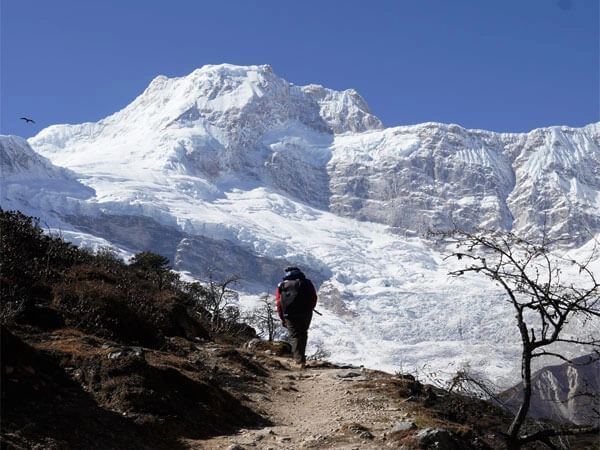
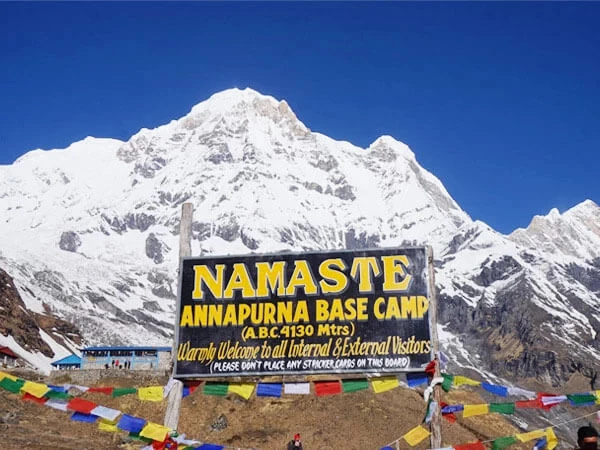
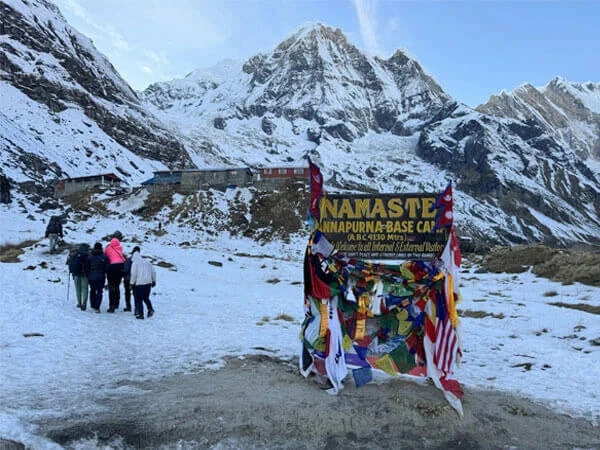
The Annapurna Base Camp (ABC) trek is a world-famous Himalayan walking route in Nepal, reaching a maximum altitude of 4,130 meters (13,550 feet) inside a stunning mountain ring known as the Annapurna Sanctuary. The standard trek takes 14 days, covering a round-trip distance of roughly 65 to 85 kilometers starting from Pokhara.
Annapurna Base Camp Trek
Standard Annapurna Base Camp Trek 14 days
Are you searching for a trekking destination in Nepal? Do you wish to spend your upcoming holidays surrounded by tranquil nature? If so, there is no need to look any further. Allow us to introduce the Annapurna Base Camp Trek, an extraordinary trek in the Himalayas.
Our Annapurna Base Camp Trek offers numerous features and highlights that make this journey truly remarkable. Among them, you can revel in the awe-inspiring landscapes and dense forests as well as immerse yourself in the vibrant culture of the local ethnic groups such as the Gurung and Tamangs.
So, why wait? Book your trip now! If you have any inquiries, our team will be delighted to assist you and make the necessary arrangements to ensure that the Annapurna Base Camp Trek becomes a splendid journey of a lifetime.
Best Highlights during the Annapurna Base Camp Trek
- Enjoy the picturesque drive to and from Pokhara.
- Explore the Annapurna Conservation Area, which is the largest conservation area in the country.
- Admire a diverse range of flora, including rhododendrons, junipers, pine trees, and bamboo.
- Cross the Kali Gandaki Gorge, which is known as the world's deepest gorge.
- Engage with the local villagers, who are mainly Gurung, Tamang, and Magar people.
- Discover and learn about the rich traditions and cultures of Hinduism and Buddhism.
- Visit the ancient Buddhist monasteries adorned with beautiful prayer flags.
- Marvel at the breathtaking views of Dhaulagiri, Annapurna, and other mountain ranges from the Poon Hill viewpoint.
- Unwind and relax in the natural hot springs of Jhinu Danda, a perfect location to alleviate the stresses of the day.
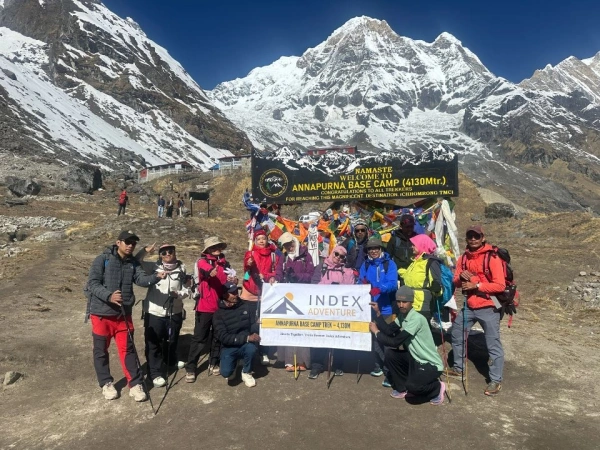
- Celebrate the achievement of reaching an elevation of 4,130 meters with your team members beneath the mountains!
Best Time
So, you are eager to broaden your horizons and plan the Annapurna Base Camp Trek soon. However, there is a crucial factor that can significantly impact your entire trekking experience: the weather conditions. While the Annapurna Base Camp Trek is accessible throughout the year, the optimal time to embark on this adventure is during March-May or September-November.
These months are considered the most favorable for the trek, as the weather conditions are conducive to hiking and can greatly enhance your overall experience.
We strongly advise against trekking during the monsoon and winter seasons. This is because you will encounter heavy rainfall and snowfall during your hike, which can pose a high risk of injuries and natural disasters. Therefore, it is highly recommended to choose only the best time for the ABC trek to ensure your safety and avoid such situations.
Difficulty Level
Before finalizing your trip, a question that is likely to cross your mind is, "How difficult is the Annapurna Base Camp Trek?" We aim to address this question and provide you with information about the trek's difficulty level.
First and foremost, it's important to note that the Annapurna Base Camp Trek is considered a moderate trek. The difficulty level of any trek is influenced by two main factors: the hiking routes and the elevation.
Let's discuss the hiking routes involved in the Annapurna Base Camp Trek. The trail comprises both uphill and downhill terrains, and you can expect to walk for approximately 5-6 hours per day, with regular breaks. While some sections may be relatively steep, they can be easily overcome. With regular breaks and breathtaking scenery along the way, you will find the trek manageable and enjoyable.
Next, let's talk about the elevation of the Annapurna Base Camp Trek. The highest point you will ascend to is 4,130 meters at the Annapurna Base Camp. Hiking at this altitude carries a relatively low risk of altitude sickness. Additionally, the itinerary for the ABC trek is designed to allow for sufficient acclimatization days, ensuring that your body adjusts gradually to the altitude.
Therefore, rest assured that the Annapurna Base Camp Trek can be accomplished by hikers of various skill levels, including beginners.
Is the Annapurna Base Camp Trek Right for Me?
The beautiful aspects mentioned above are few reasons that have attracted trekkers in the past. However, to add more, there are many great reasons to choose the Annapurna Base Camp Trek, which you will discover on the trail. On the same note, one of the primary reasons to choose ABC trek is its convenience. Pokhara- the start point of the trek is accessible by land as well as by air. Therefore, trekkers who despise wasting time by waiting won’t have to worry about that. The hike itself is attainable by both trekking experts and novices alike as it does not require going to the high altitudes like other challenging packages such as Everest Base Camp Trek.
Furthermore, many visitors consider the Annapurna region’s alpine scenery to be the most beautiful in the entire country. The ABC trek will take about two weeks of your time. If you want to visit this region of Nepal briefly, consider our Annapurna Panorama Trek or our Ghorepani Poon Hill Trek, both of which can be completed in about one week.
Alternative Treks You Can Consider!
Well, the Annapurna Base Camp Trek is wondrous, isn't it? If you still want to look for more trekking packages, we want to suggest some to you. Let's look at some other treks that lie in the Annapurna region.
Firstly, you can look at the 11-day Annapurna Base Camp Trek with a round-trip flight to/from Pokhara, where trekkers can enjoy the trek and marvel at the foothills of the Base Camp but excludes overnights in Pokhara.
Another trekking package would be Instant Annapurna Base Camp, which is just a 9-day trek. In this short amount of time, you can reach the Annapurna Base Camp and enjoy the moment. Are you looking for more information about this trek?
If you require further information about this trek, please feel free to send us an email, and we will respond to you promptly.
Why Choose Index Adventure for your standard ABC Trek Package?
First of all, Index Adventure has years of experience in this field. Thus, they know what clients expect, and they have never failed to exceed the client’s expectations. You may check what our previous clients have to say about us on our TripAdvisor page.
Secondly, Index Adventure puts the safety and the well-being of the clients as their foremost priority. For them, customer satisfaction is everything. Thus, they work very hard to make sure clients are having the best time while in Nepal.
Thirdly, our expert team of trekking staff. Our staff and trekking guides are well-spoken, professional, have years of trekking experience, and have vast knowledge about mountains and the life that resides there. So, you are in the hands of experts who have immense knowledge about their job. Similarly, you are in the care of people who will keep your safety and well-being as their topmost priority.
All in all, we esteem your valuable time and fulfillment, so we make a solid effort to offer the best of the best for you and make your time advantageous, fulfilling, and exceptional.
You Will See & Explore


Annapurna Base Camp Trek Itinerary
Let's take a look at our Annapurna Base Camp Trek Itinerary.
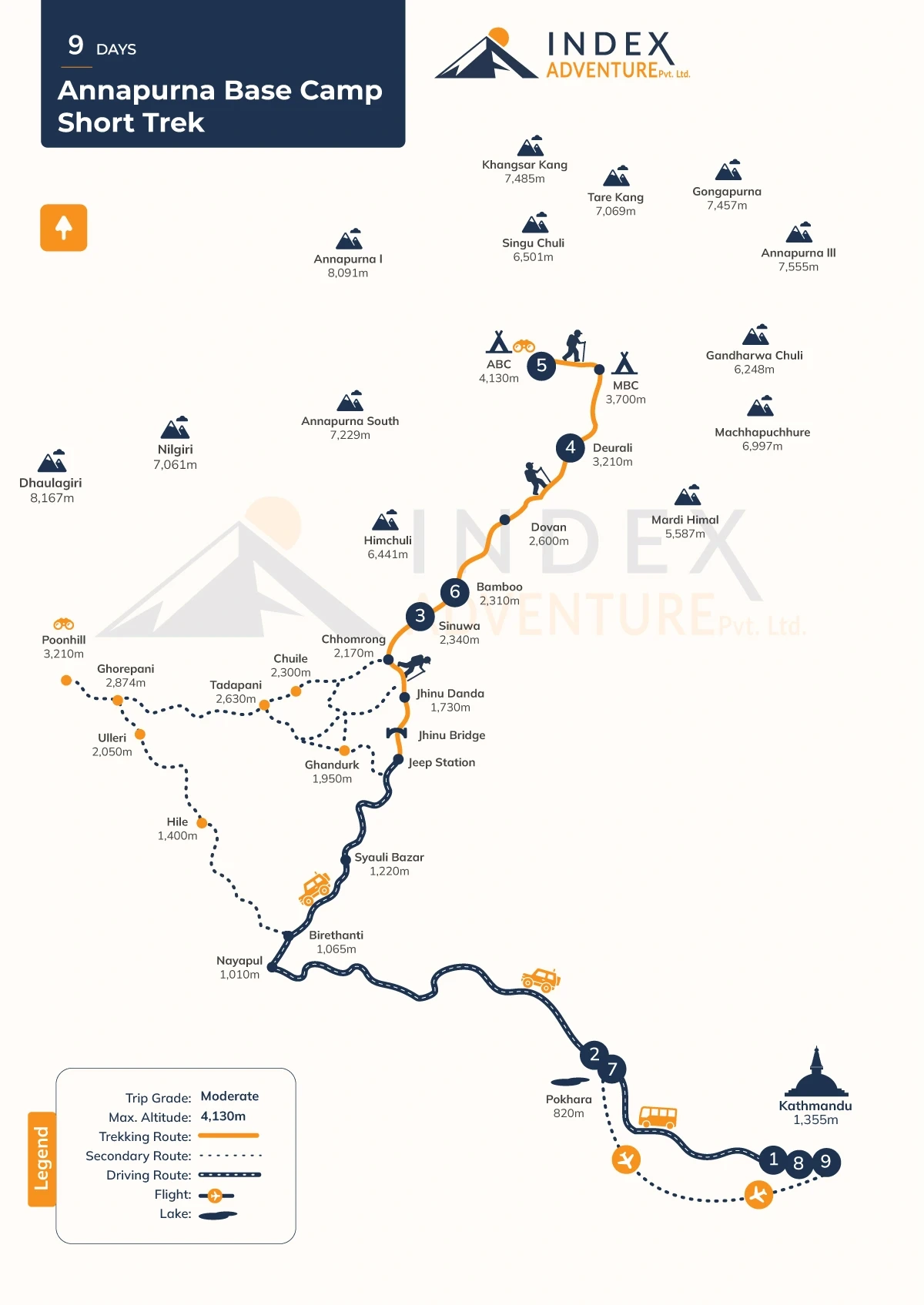
The journey commences upon your arrival at Tribhuvan International Airport, Kathmandu. As you exit the airport, you will spot one of our representatives holding a display board for Index Adventure. They will accompany you to the hotel where you can relax for the night. Next, we will embark on a picturesque drive from Kathmandu to Pokhara.
Upon arrival, you will spend the night resting and preparing for the hike. After a ride to Birenthanti, we will begin the hike towards Ulleri. Then the next day, proceed to Ghorepani. The following morning, we will rise early and hike to the Poon Hill viewpoint. From this viewpoint, you will be rewarded with magnificent vistas of Dhaulagiri, Machapuchare, Hinchuli, the Annapurna ranges, Dhampus Peak, and Dhaulagiri II.
After witnessing the sunrise at Poon Hill, we will continue our journey to Tadapani, Chhomrong Village, Dovan, and eventually reach Deurali. Finally, we will reach our ultimate destination, the Annapurna Base Camp, via Machhapuchhre Base Camp. From there, we will descend to Bamboo, Jhinu Danda, and then drive back to Kathmandu.
You will meet one of our staff at the airport waiting for you with a placard of the Index Adventure. He will assist you in guiding you to your trip Hotel. At the hotel, we will conduct a brief meeting explaining the nature of the trip. After the meeting, no other activities are planned. Thus, you may rest or follow any different schedule you would like.
Overnight at the Hotel in Kathmandu.
On the second day, have an early breakfast and prepare for your departure to Pokhara. The journey to Pokhara is via bus, and the drive entails watching the scenic pastoral landscape of Nepal.
You will see giant hills, distant mountain views, rural villages, terraced farms, and rapidly flowing rivers throughout the trip. Watching this beautiful scenery, you will reach Pokhara- the city of lakes and mountain scenery. Check in to the hotel and after the drive, if you are energetic, go for an evening walk around the lakeside city.
Wake up early in the morning, have breakfast, and get ready for a long day. Your destination for today is Ulleri, and for that, you will first take a drive to Birehthanti.
You start your first hike of the trek from Birethanti. Crossing a suspension bridge, you will come across steep stone stairs that bring you to Ulleri- a beautiful Magar town.
Overnight at the guesthouse in Ulleri. All three meals are included.
The trip to Ghorepani begins with a warm breakfast. It is a steep climb, so approach the route gently. Taking on the green pastures, you reach the crest of Ulleri hill, leading you to a campground to take a small but necessary break.
After the break, continue hiking to reach Nangethanti for lunch. Following the trail, you will arrive at the traditional village of Ghorepani. All through the hike, you will be rewarded with breathtaking mountain scenery.
Overnight at the guesthouse in Ghorepani. All three meals are included.
Today’s itinerary consists of a small hike to famous Poon Hill to see the majestic sunrise view over the gigantic Annapurna massif. After soaking the mesmerizing sight, return to the guesthouse, have your warm breakfast and start your hike towards Tadapani. Hike along the ridgeline and through a pleasant rhododendron forest before reaching Tadapani.
Overnight at the guesthouse in Tadapani. All three meals are included
Parting from Tadapani, today, you hike towards Chomrong village. The route to Chomrong is a gradual descent, and it consists of crossing suspension bridges, walking past rhododendron forest, and hike along with the crop fields. As the trail mostly goes through lush jungles, birds become your companion and a reason for fascination. Watching their colorful wings flap when they leap from one tree to another is a rewarding sight. Admiring these creatures, you will eventually reach Chomrong, where villages sprawl across the hillside with Majors Mountains such as Huinchuli, Machapuchare, Annapurna South towering the town.
Overnight at the guesthouse in Chomrong. All three meals are included.
We’ll bid the genuine hospitality of Chomrong goodbye and descend towards Dovan. Elevation gain is quite a bit more than other days, so you must approach the journey smoothly. You will hike down 2500 stone steps and cross Chhomrong River through a suspension bridge. After that, ascend through a rocky trekking route that leads to Sinuwa village and continue the hike through the dense forests towards Kuldahar (2540m). From Kuldahar, you will descend to bamboo and take on a gradual ascend from there to Dovan.
Overnight at the guesthouse in Dovan. All three meals are included.
Saying bye to Dovan, you follow a serene, emerald-green forest of bamboo and rhododendron route towards Deurali. The trekking course is dotted with prayer flags giving a vibrant flair to the surrounding.
Before continuing your walk, take a moment to appreciate the unique ambiance. The forest quickly fades away, leaving a barren landscape strewn with boulders and scree in its place. When you walk by the Himalayan Hotel, you’ll know you’re getting closer to your destination. Continue climbing past this landmark to Hinku Cave, which was once used as a shelter and overnight stop for historical Annapurna expeditions. Your trek for today concludes at Deurali.
Overnight at the guesthouse in Deurali. All three meals are included.
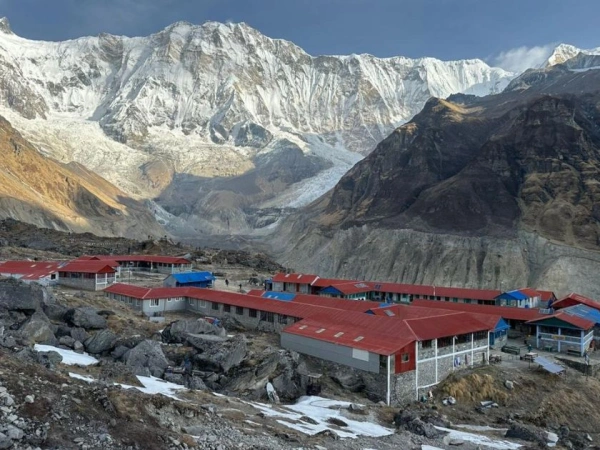
This is the most awaited day of our long hike. You will finally reach Annapurna Base Camp today. The journey for the day begins by climbing a riverbed and hiking up to Annapurna Sanctuary. The height gain is quite much today, so as always, be careful and don’t rush the trek. The trek route also follows the Modi Khola trail and will, in due course, bring you to Macchapuchre Base Camp. Take a break at Machhapurchhre Base Camp and admire the Himalayas surrounding the areas. And after a while, depart from the splendors of MBC, and hike for another 2 hours to reach Annapurna Base Camp. The actuality of getting to the base camp becomes more prominent when giants’ views are so close to your eyes. The base camp is towered by impressive peaks of the Annapurna range and its neighboring mountains.
Overnight at the teahouse in Annapurna Base Camp. All three meals are included.
Today, we bid bye to the magnificent Annapurna Base Camp and head towards bamboo. As we are descending to low altitude, please be mindful of your walking pace. Following the same trail to base camp, descend to Modi Khola to reach the rural village of Bamboo. The town is surrounded by mountains so take into panoramic scenery of the mountains.
Overnight at the guesthouse in bamboo. All three meals are included.
Today, you will descend to Jhinu Danda Hot spring. The trail to Jhinu Danda winds down through wooded slopes to Chomrong via Khuldighar.
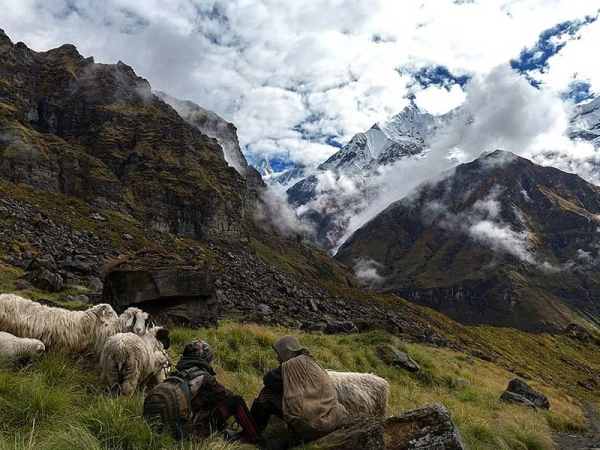
From Chomrong, the path gets steeper as it descends towards Jhinu Danda. While dropping, make sure to visit the experimental sheep farm, which shows a glimpse of herder’s life in the mountains of Nepal. Observing these exciting aspects of rural life, you will reach Jhinu Danda.
From here, if you hike down about half-hour, you will get to a natural hot spring. This is the ideal spot to decompress and let the stress of the day wash over you.
Overnight at the guesthouse in Jhinu Danda. All three meals are included.
Your trekking trip is almost over now that the Himalayan views are behind you. We cross the suspension bridge and then drive to Pokhara by jeep which takes about 2 hours.
Overnight at the hotel in Pokhara. Breakfast and lunch are included.
Now that your trek is complete, you’ll return from Pokhara to Kathmandu by tourist bus.
If you are tired of a long bus journey, then you have the option of flying to Kathmandu at an extra cost.
The cost for Pokhara to Kathmandu is USD 100.00 per person for one way flight. The choice is yours. Nevertheless, it would incur an additional fee.
Overnight at the hotel in Kathmandu. Breakfast only included.
Today marks the end of the trek. Our office representative will be at your trip hotel approximately 3 hours before your departure flight to transfer you to the airport.
Cost Details
Includes
- International airport pick up and drop off by private vehicle.
- 2 Nights 3-star Hotel in Thamel, Kathmandu with BB Plan.
- 2-night accommodation in the Standard Hotel in Pokhara, BB Plan.
- Tourist bus ticket from Kathmandu -Pokhara - Kathmandu.
- Sharing a jeep or local bus from Pokhara to Jhinu Danda & Jhinu Danda to Pokhara.
- 4 nights' Trekking lodge / Teahouse accommodations during the trek(twin sharing).
- 3 times meals a day (Breakfast, Lunch, and Dinner), a cup of tea or coffee during the trek.
- Government register expert with a professional English-speaking trekking guide, including accommodation, food, transportation, equipment, and salary.
- All necessary paperwork and Annapurna National Park entry permit, Trekker’s Information Management System (TIMS), including local Tax, Government tax & official expenses.
- (if needed) Sleeping bag, down Jacket & Duffel Bag (to be returned after trip completion).
- Duffle bag, and a company T-shirt (complimentary).
- Free luggage storage at the Index Adventure Store.
- Farewell Dinner & Trekking Achievement Certificate.
- Exclusive Medical Kit Bag.
Excludes
- International airfare, all kinds of travel insurance, and the Nepal visa fee. (You can apply online, or you can easily issue the visa on arrival at the International Airport in Kathmandu. ( For a Nepal Visa, 15 days - $25-30, 30 days- $40-50and 90 days- $100-110).
- Extra nights' accommodation & lunch, and dinner in Kathmandu & Pokhara city.
- Personal expenses such as all kinds of drinks, hot showers, battery charging, extra meals, and wifi laundry.
- Travel and rescue insurance (necessary).
- Additional Costs or delays caused due to Circumstances beyond our control. Example: bad weather conditions, landslides, illness of government policies, strikes.
- Porter to carry your luggage during the trek. Please, if you would like to take a porter, you can check our Add-ons Details option.
- Tips for guides and porters.
Add-ons & Options
With us, Index Adventure, the Annapurna Base Camp Trek 14-day journey carries quiet gifts along the way—small touches, deeply rooted in care. Our add-on services aren’t surplus; they’re gentle hands that steady your path, warm moments around shared tea, and local wisdom that opens the trail like a conversation, making your Annapurna base camp Trek premium.
Each offering is chosen not to impress but to hold space for you to feel the adventure of Annapurna Base Camp more fully, more closely, more truly.
Porter Service – US$115: Let our experienced porter carry your load, so you can wander freely and take in the beauty around you. One porter can be shared between two trekkers, carrying a total of up to 25 kg (55 lbs).
Flight from Kathmandu to Pokhara -US$115 per person (Flight Time 15 minutes).
Flight from Pokhara to Kathmandu -US$115 Per Person (Flight Time 15 minutes).
Annapurna Base Camp Trek Route Map

Dates & Availability
Fixed Departures 2026 and 2027 for ABC Trek Package
|
Season |
Departure window |
Availability |
|
Autumn 2026 |
Late September to late November |
Booking now |
|
Spring 2027 |
March to May |
Booking now |
|
Autumn 2027 |
Late September to late November |
Booking now |
|
Private departures |
On request, subject to season |
Year-round |
Essential Information
Airport Pickup and Drop off for Annapurna Trek
We do provide airport pickup and drop-off services, so you do not have to worry about finding a taxi or a way to your hotel. Our office representative will be at the airport holding a placard with our company name, which will make it easier for you to find us. Our office representative will then drive you to your hotel.
Visa in Nepal
Well, obtaining a visa in Nepal is very easy. Nepal offers an On-Arrival visa at the Kathmandu (TIA) airport. However, people from a few continents are not eligible for an arrival visa. These countries are Ghana, Ethiopia, Swaziland, Cameroon, Afghanistan, Palestine, Iraq, Syria, Liberia, Somalia, Zimbabwe, Nigeria, and refugees.
They are requested to consult with the Nepal embassy or consulate office of Nepal based on their homeland. Except for these countries, people from all other continents can apply for an Arrival Visa. It is an easy process. However, you may have to stay in a long queue during the peak trekking season.
Similarly, people coming from India can also obtain visas from the Nepal – India border. And the same goes for people coming from Tibet. They can obtain a visa from Nepal – Tibet borders.
Documents for Visa
You need an original passport with a validity of at least six months. After that, you need to carry two passport size photographs and cash for the visa fees.
Accommodation for ABC Trek
Our standard trekking packages include 3-star category hotels in Kathmandu and Pokhara. You can extend your hotel stay in Kathmandu, and it will cost approximately USD 50 and USD 55 per night, inclusive of breakfast, for a single and double/twin room, respectively.
You can upgrade your accommodation in Kathmandu and Pokhara, or you can choose a luxury Annapurna Base Camp Trek as well. You can consult your preferred hotel with us, and we shall reserve the accommodation in your preferred hotel.
During the trekking portion of Annapurna Base Camp Trek, you will be accommodated in a guesthouses. The rooms at the guesthouses are neat and clean and bathrooms are mostly built inside the housing area. In this trek route, Ghorepani is the only place where rooms with attached bathrooms are available. Likewise, up to Chomrong village, teahouses have rooms with twin beds to share amongst two trekkers.
However, after Chomrong, there are a limited number of teahouses so in one room there will be multiple beds. And during the peak trekking season, 3 – 4 trekkers will have to share one room; each person will get a bed to sleep.
The beds at the teahouses are already set up with a mattress, bed sheet, pillows, and blankets for your comfort.
Food and meals in Annapurna Base Camp Trek
You can find all sorts of food/meals on the trek. From international dishes to local Nepali cuisine, you can find all types of dishes on the trail. The most preferred dish would be Dhal Bhat (traditional Nepali meal) as per our previous trekkers. They expressed that it is fulfilling and healthy. Besides, trekking staff always prefer Dhal Bhat over any other dishes.
Other than that, the teahouse does have a set of menus with a variety of food items. You can choose your preferred dish from the menu if you want to eat something else besides Dhal Bhat. Cooks at the tea houses will prepare the meals you like.
Likewise, if you are vegan or have dietary restrictions like gluten-free meals, then don’t worry. Because cooks will prepare the meal as per your request. However, you may have to explain to them what these conditions are and your preference. Because many of them are not aware of these restrictions. All in all, whatever dietary restrictions you have it will be met.
Drinking Water
Firstly, we urge everyone to bring their water bottle. Secondly, in the Annapurna Base Camp trekking route, bottled water is banned. On the trail, there are plenty of drinking water taps from where you can access water without any cost.
However, even though it is drinking water, we would suggest you filter the water before consuming it. You can use water sterilizing tablets which will filter your water. And another way to access water is to buy safe drinking water at the teahouse. The quality of the water that the teahouse provides is the same as the bottled mineral water. It is not costly but you need to have your water bottle.
Toilets and Hot showers
Two types of toilets are available on the trail. You will find classic squat-down types of toilets and western flushing types of toilets.
Almost all of the tea houses provide hot shower facilities. Whether it be a hot bucket shower or a hot tap shower facility, you will get either one facility on the trail. As you approach higher elevation and get cl to base camp, getting a hot shower facility is challenging. So, in the upper region, you will have to buy a bucket of water and bath unconventionally.
Also, during the peak trekking season, tea houses struggle to provide hot shower facilities due to high demand. All the tea houses will charge you a certain amount for a hot shower depending upon the location.
Best Time for Annapurna Base Camp Trekking
When trekking in Nepal, amongst many things to consider, the weather is one of the important factors. Annapurna Base Camp trek can be done all through the year. However, the environment and the weather do not remain perfect throughout the year. However, amongst all the trekking seasons in Nepal, for Annapurna Base Camp trek, autumn and spring seasons are one of the best times to do the trek.
If you would like to see lush green valleys, then we suggest you opt for the trek around the spring season. This time of the year offers warm days and chilly nights making the weather perfect for the visitors. Likewise, during the autumn season, the skies are clear and mountain views are spectacular. This time of the year, you can get the most beautiful views of the mountain range. You can also do this trek during the winter season, however, during this time of the year, there is a chance of heavy snowfall making the trek challenging.
Likewise, monsoon season is also perfect if your purpose of the trek inclined more towards nature. Because during this time of the year you will see nature blooming on its own. Nonetheless, you will have to get used to the frequent visit of leeches and worms if you opt for monsoon season. Every season has its flaws and benefits.
Spring and autumn provide stunning mountain views however it is one of the busiest times of the year too. Likewise, winter and monsoon have their seasonal flaws but one advantage of traveling during this time of the year is that you will get to have the trail to yourself. As it attracts a smaller number of trekkers due to its seasonal blemish.
All in all, whether in the Himalayas is unpredictable and changes frequently. So we suggest you expect the weather to change quickly.
Group or Private Trek
If you are a solo traveler, we recommend you to join the group trek on your best convenient date from among our available guaranteed schedules mentioned on our website.
If you are two or more, it is advisable to choose a private trek as it will be flexible and also you can walk at your own pace without having to worry about matching up your speed with other fast or slow-paced trekkers. We organize private group treks for a minimum of two or more people without any extra cost.
Can Beginners do Annapurna Base Camp Trek?
Annapurna Base Camp trek is certainly one of the best trekking trails for the beginner. The trek begins from Ulleri which is at the height of 1495m. This height is a normal elevation to start a trek. And in the span of 9 or 10 days depending upon your itinerary, you will reach 4,130 m.
If you reach this height in 9 or 10 days, it is a gradual approach so you will not have a complication. Due to this reason also, it is a moderate level of the trek. Besides, you will be guided by our expert trekking leader who has wide knowledge about trekking in Nepal and Annapurna region. Thus, he will escort you gradually to your destination.
ABC Trek for Children
Indeed, children can do this trek. Annapurna base camp trek is a moderate trek which is attainable by all age groups of people. However, trekkers trekking along with children may need to opt for a little different itinerary than the usual one that adults follow. Because although kids are fit enough to walk straight for 4-5 hours, it will somehow exhaust them for the next day.
So, if you are looking to do this trek with kids, we have another version of Annapurna Base Camp Trekking
Training for Annapurna Base Camp
For the ABC trek, we would suggest you to start training and preparation at least 1 month before the trek date. Any exercise that will increase your endurance level is recommended.
Besides that, we would also advise you to do cardio exercises, swimming, walking, and hiking at least once a month. Doing these activities will prep you for the trek. And this preparation is amply enough for the trek.
Difficulty of Annapurna Base Camp Trek
Annapurna Base Camp trek is not a difficult trek at all. As mentioned earlier, it is a moderate level of the trek. So, with proper pieces of training and exercise, you can complete the trek without any hesitation.
Besides, there will be trekking guides who will be looking after you and your needs. Following the tips and techniques of the trekking leader, you can complete the trek efficiently. Thus, Annapurna Base Camp Trek is not a difficult trek; rather a moderate level of the trek.
Altitude Sickness in Annapurna Base Camp Trek
Firstly, we would suggest you to not rush the trek even if you are energetic and think you can walk for another 4 or 5 hours. It is very unhealthy and dangerous while trekking in high altitudes. On the same note, staying hydrated is also very necessary. While trekking, drink at least 4 to 5 liters of water daily. This will avoid getting mountain sickness. Likewise, we would also advise eating soupy foods that can be easily digested. Although food does not have much relation with altitude sickness however eating a heavy meal can give you digestion problems.
Additionally, you should not drink while on the trek. Drinking will easily give you a headache, which can result in altitude sickness. Also, you can intake Diamox pills too. You can purchase these pills in the pharmacy without a doctor’s prescription. These are some very important tips to remember while trekking in Nepal. These will help you to avoid the chance of getting altitude sickness.
Electricity and Devices
Yes, electricity is available to charge your phones, camera batteries, or any other devices. However, you will have to pay for these services. Not all the teahouse charges money for using electricity to charge devices. But many will charge you extra costs.
So, it is our suggestion to discuss the cost with the teahouse owner before using the service. Normally, it cost about NPR 200-300 to charge phones and camera batteries.
Network and WiFi during Annapurna Base Camp
Yes, phone reception is available in most of the places during the trek. Likewise, WIFI services are also available on the trail. To use WIFI services, you are expected to pay a fee. These fees increase as you scale up to higher altitudes.
Usually, the cost of WIFI services ranges from NPR 400-500 each, depending on the location you are staying in. And another option to stay connected with your family back home is by using an internet data package if you have a local SIM card.
You can buy a SIM card around the street of your trip hotel in Kathmandu/Pokhara or ask your guide to arrange it one for you. However, we must inform you that internet service may not be strong in all places.
Travel Insurance for ABC Trek
Yes, to cover the unforeseen risks, travel insurance is a must for all travelers coming to Nepal. We have a recommendation list of some travel insurance companies around the globe on our site. Please go through the link to get more details about it.

Equipments
Things to Pack for ABC Trip and Trek
What should be on your packing list for trekking, in case you are going on an adventurous trekking tour to Nepal? Nepal boasts one of the most magnificent scenic views, spectacular mountains, and diverse cultures, making it a dream global trekking destination. Before trekking in Nepal, one needs to be well prepared because of the different terrains, weather conditions, and altitudes. In order to get the best out of your trekking visit, this ultimate packing guide of trekking in Nepal will cover all that is essential: a list of items you could carry with you, clothes, supporting trekking gear, hygiene, documents, etc.
Preparing to go trekking in Nepal can be very overwhelming, but with the right gear and equipment, you should be in a position to withstand anything that the path presents to you. This list is designed for the Annapurna Base Camp Trek. The list can be adjusted depending on the trek's difficulty and season. This latest and updated travel checklist to pack smart and trek with confidence.
List of essential packing items
In trekking, there are thousands of trekkers using costly fashion equipment, and they use outdoor fashion, but we advise you to be ready with hiking equipment that is comfy and sturdy.
- Insulation Layer (Fleece/Down Jacket): Will be needed during cold weather.
- Thermal Base Layers: Help to keep the body warm when it is cold or when it comes to high altitude.Your second actual skin; bring the highest quality (2 sets).
- Fleece Pullover Hoodie: a garment that keeps you warm even when the water condenses on the inside when it is raining. Taking two, both at low-level and at high-level, comes in handy.
- Lightweight Thermal Tops: This is cool when you do not wear a base layer.
- Water, Rain, and Snowproof Outer Shell: recommended to use water, rain, and snowproof (in case of bad weather).
- Hiking Shorts(Optional): They can be good in lower altitudes and on sunny days.
- Hiking T-Shirt (2-3): convenient, breathable, fast-drying tops to wear every day. At a lower altitude.
- Trekking Pants ( 2-3): Loose, comfy pants, flexible, to be comfortable on the trail. Lightweight, quick-drying paints (no jeans, please).
- Down Pants: Bonus heat at night or at a high altitude trek.
- Liner + Insulated Gloves: Cold hands will be kept warm and will be isolated from wind and snow. Should take two light ones and a heavyweight water/windproof. Cold hands will be kept warm and will be isolated from wind and snow.
- Sports Bra for Girls: When you are hiking, a good sports bra should be considered.
- Sportswear Underwear(5-7 pieces): Moisture-wicking to avoid annoyance and irritations. Quick dry.
- Woolen Hat: This will come in handy when it is starting to get cold in the evenings and in the morning hours to keep your head warm.
- Sun hat/ Cap: It protects one against the Sun at high altitude.
- Neck Gaiter/ Buff: Very useful in the sun and dust or cold wind.
Footwear for Hiking in ABC
- Trekking Socks (3-5 pairs): These socks are meant to lower the possibility of blisters and visible processes that take a short duration to dry.
- Warmer Socks (1-2): Wear during sleep or in an unfavorable climate in cold weather.
- Trekking boots: A pair of sturdy, already used and comfortable, up-to-the-ankle boots made to provide support, traction, and repelling during mountainous and rough trail activities.
- Trail Running Shoes: These are breathable and lightweight and are ideal when on more maintained paths or elevations, where the shoes do not need tough materials.
- Camp Shoes/Sandals: It is convenient, comfortable, and wearing shoes that are worn to house overnight camp or river crossing after a strenuous day of trekking.
- Gaiters (Optional): These cover over the boots so that one is protected against the snow or rain, or on muddy footpaths, dirt will not enter the shoes.
- Crampon-compatible Boots: In case you are planning to trek into high-altitude or glacier-covered parts, then crampons are a must on icy surfaces that cannot be fitted into just any boot.
Gears and Equipment for trekking in Annapurna BC
- Packing a Backpack 30-50L on a personal basis: Its contents include items such as clothes, snacks, and water that may be carried around during the day.
- Duffel Bag 70L: A Larger bag used to carry most of your equipment, which must be waterproof. It should be recommended only when you are going to use Porter.
- Daypack with Rain Cover: A day pack is also essential on your trekking adventure in Nepal, regardless of whether you are carrying a porter or not. Day pack size recommendation is 25-30L with a rain cover, which keeps water and snow out of your pack and contents.
- Sleeping Bag Liner ( -20 °C.): Also, it is highly advisable to bring your own after coming from a sleeping bag, and in case you plan to rent a sleeping bag. Insulates and makes your sleeping bag less in need of washing.
- Trekking Poles: This is optional, though being knowledgeable of their use will help lessen the burden on the knees and enhance steadiness on inclined or uneven ground.
Accessories for trekking in ABC
- Extra Batteries Headlamp: These can be used on early morning walks, during power failure, or when one arrives late.
- Water Bottles / Hydration Bladder: Makes you hydrated; it is easier to drink on the move as the bladder can be sipped from. Plastic waste can be reduced through the use of a reusable water bottle.
- Water Purification Tablets or Filter: Garfores are the local sources used in providing safe drinking water.
- UV Protection Sunglasses ( UV Protection): Cover the eyes against excessive sun and snow lights.
- SPF 50+ sunscreen/SPF lip balm: Avoids sunburn and dry lips, too.
- Towel (Quick-dry): To wash, or wipe at teasssshouses or streams.
- Toiletries: (Eco-friendly): Toothbrush, toothpaste, a sheet of toilet paper, and biodegradable soap.
- First Aid Kit (Personal): Covers the essentials of bandages, an antiseptic, altitude medication, pain relievers, and any particular medication you might need.
- Snacks ( Energy Bars, Nuts, Chocolates ): Come in handy to provide instant energy when hiking hours are long.
- Notebook and Pen (Optional): To journal or document life.
- Trash Bags: Carry some trash bags to pack and dump your waste, and keep them clean.
- Phone Charger: Have a fully charged cell phone and car charger.
- Power Bank: A power bank means that your gadgets do not run out of power.
- Local SIM Card: Buy a local SIM card (NTC or NCELL) that will enable you to connect well in distant regions.
- Cash (Around 25k to 30k NRS): Keep some cash along with that, which will help you take care of the expenses because on the trek route, ATMs may be few.
- Map and Compass / GPS: Always bring the appropriate geographical tools to prepare yourself.
- Camera and Binoculars: A camera and binoculars can be used to take pictures of the beautiful landscapes and to observe animals.
Documents for Trekking in Annapurna Base Camp
- Passport: Should be valid for more than 6 months, required when making identification, booking of flights, checking in to a hotel, and applying for permits.
- Nepal Visa (Some countries need to obtain this in their homeland): One must have a tourist visa to enter Nepal, and it can be acquired either on arrival at the Tribhuvan International Airport or online.
- Trekking Permits: Get permits of any kind that you will need when taking the particular trekking route.
- Passport-sized Photos (For now, digital and instant photos click options are available): Required by such things as TIMS (not necessary) and park entry; take about 4-6 copies
- Travel Insurance (with emergency evacuation): Highly advised when hiking in high altitude; it is necessary to ensure helicopter rescue, sickness, accidents, and trip cancellation.
- Airline Tickets / Itinerary Copies: On international flights, as well as domestic flights (e.g., to Lukla, Pokhara); handy at the checkpoints, or in planning.
- Permit Payment Proof: You can be asked to show a receipt or a copy that you have paid your permits in the trails or at the entrance to the park.
- Address to use in cases of emergency: Ought to be handy or given to your trekking agency or guide.
Trekking Equipment Provided by Index Adventure
- Quality Sleeping Bags (-15 degrees Celsius rated): For warmth and comfort during the trek, especially at higher altitudes.
- Premium Down Jackets (-15 degrees Celsius rated): Provide essential insulation against the cold.
- First-Aid Kit: A comprehensive kit with necessary medications, an oximeter, and supplies for minor injuries and illnesses.
- Crampons: For traversing icy and snowy paths.
- Water Purification Tablets: To ensure safe drinking water.
FAQs for Annapurna Base Camp Trek
If you are travelling through air then you can only enter Nepal through Tribhuvan International Airport; is the only international airport in Nepal that operates several international flights on a daily basis. The airport is located in the capital city: Kathmandu, which is a popular hub for tourists visiting Nepal.
If you are travelling through road ways then you can either enter from China Border and India Boarder but before entering Nepal you should report yourself to Nepal Entry/Exit Points. Some of road entry/exit points are:
From China: Rasuwagadi Border & Kodari Border.
From India: Dhangadi, Kanchanpur, Nepalgunj, Birgunj, Kakarvitta, Bhairahawa
Reference: http://nepalimmigration.gov.np/content/immigration-offices--entry--exit-points-1.html
Yes! Except for the citizens of India, you need to get yourself a Nepalese visa to enter the territory of Nepal. If you are an Indian citizen a valid identity would be enough to enter Nepal via the entry points.
Nepalese visa is easily available upon your arrival at any entry points (ref Q.N 1). Yes, you can get on arrival tourist Visa at Tribhuvan International Airport in Kathmandu there are some countries visa will needed $ 25 for 15 days, $ 40 for 30 days and $100 for 90 days tourist visa from the dates of issue.For Tourist Visa, you need to bring along your valid passport ( must be valid up to 6 months ,just in case extra photocopies of passport ) and few copies of passport sized photograph.
You can apply online visa also. https://online.nepalimmigration.gov.np/
Necessary Documents to bring/carrywhile traveling in Nepal are:
- Copy of your travel insurance,
- Emergency contact numbers of insurance agent and family members/friends
- Immediate cash and
- And any special medicine.
Note: The resident of countries like Nigeria, Ghana, Afghanistan, Zimbabwe, Somalia, Cameroon, Swaziland, Iraq, Ethiopia, Liberia, Palestine do not get visa in the entry point of Nepal.
Yes! Nepal is the safest country for the travelers around the world.
Upon your arrival, you can exchange your currencies at Tribhuvan International Airport but it might be low rate than other exchange places. However, banks do accept other countries' currencies too. All major banks of Nepal provide currency exchange services. Or the other option might be, exchanging your currency with the licensed money exchangers in major citieslike Kathmandu & Pokhara and mostof the commercial banks have ATM machines in major cities and towns of Nepal like Kathmandu and Pokhara where you will be able to withdraw money from your home country bank using your ATM card.
Trekking in Nepal can be done anytimeof the year, except for monsoon. During monsoon (June-August), trekking becomes a bit difficult due to heavy rainfall and unpredictable weather. However, the best time of the year for trekking in Nepal lasts from month of March-May (Spring Season) and September-November (Autumn Season).
You will be able to do all these activities in Nepal, yet they completely differ from each other. Trekking is a multi-day walk where you stop at various destinations along the trail. Generally, hiking refers to one day walk up from 2 hours to eight hours which might be a one or two day event. Mountain climbing is an adventurous activity which requires special gears and training, and is more risky than that of trekking and hiking as you climb the summit of mountain peak.
This relies upon where you go and in which season you travel. Nepal has 3 different regions for climate where Himalayan region is mild cold in summer and freezing cold in winter, in Hilly region all whole year climate is suitable for travel but in Terai region the summer is very hot and in winter is too cold.Weather in the Himalayan region is unpredictable. Around the morning, evening and night, it normally gets cold yet the days are warm. Winter (December to February) will be bit colder however the days will still be very delightful and comfortably warm if the sun is out. There might be some snowfall during the winter in high elevation places. You should always carry some warm clothes while trekking in the higher elevations, whatever the season.
One must possess a moderate level of physical fitness, past hiking experience, should not retain any chronic or subtle health issues especially in leg functions, and must be able to mentally adjust for multi-day treks in the remote areas. If you match all of the above criteria, then you are ready to trekking Nepal.
The duration of your trek and the choice of the destination determines the difficulty and length. Generally, the duration lies from a minimum of 5 days to a maximum of 30 days or even more. This relies upon the Trekking route that you've chosen however; normally we will be walking close to five to six hours per day. There are different types of trekking grading from easy, moderate and changeling.
Tea house trekking refers to a trek where all your accommodation and meals are organized in a lodge/house with subtle services.
Camping trekking is a trekking where we furnish you with tent settlement and full board with dinners to be cooked by proficient trekking cook in a versatile camp, outfitted with a kitchen and with satisfactory care staff of kitchen assistants, aides and porters.
The meals and water available in lodges and camps are hygienic enough while trekking in Nepal.The predominant daily food of people in Nepal is lentil soup and curried vegetables with rice, typically called "Daal, Bhat,Tarkari” in Nepali. You might find the curries often spicy and oily which might bring out stomach problems to the foreigners. Along the Trekking trail will be simple, mix of local and international cuisine.Hence, we would suggest you to stick with normal, less spicy food. Another thing that one ought to know about while visiting Nepal is to drink packaged mineral water unless you are sure that the water is boiled, filtered or you can refine with water medicine tablets.
Since there are numerous restaurants serving vegetarian foods in Nepal, there is no problem in being a veggie lover. You can easily get vegetarian food even when you enter normal restaurants.
If you want to make your trip considerably comfortable and hassle free, you ought to hire a porter or a guide. A porter will carry your belongings while a guide will lead you to your destination conveniently, and they aid you in any kind of emergency, so it would be an ideal decision to take a guide with you.
- Private Guide + Porter
- Private Guide + No Porter
- Porter-Guide (Combined Person)
- Small Group Trek with Guide + Porter or Yaks
Tips are highly expected by every porters and guides whom you go with. It is nice and acceptable way of saying thank you for their support and help during your whole journey. Normally, we suggest to tip around 10-20% of total trip cost. And, they feel happy when you pay tip in Nepali rupees because they felt difficulties to exchange while you pay them in your currencies.
Nepal is the safest place to travel. Nepal lies in the safest place or destination for every foreigners who wants to travel Nepal. Travelers needs to fallow basic rules so that they can explore the Nepal freely. A reputed and legally register travel company used to organize and manage your whole trip. So there will be no any problem during your visit. During your long trip there will be one Nepali Guide with you and he/she will handle your all issues and tells you do's and don'ts during your visit. Some of the basic rules are listed below.
- Do not trek alone.
- Do not display your cash and expensive items.
- Ask your immediate queries with us and our representatives.
- Have your travel insurance and leave a copy to us.
- Leave a copy of your passports and other important document to us.
- Don’t hesitate to ask any questions to your travel planner and your travel partner.
We are here to support you to make your travel memorable. You should fully believe on us.
Firstly, Nepal is referred as one of the safest countries in the world, so Nepal indeed is safe for solo female Trekkers as well. Besides, while you're on one of our treks, we assume individual liability for your prosperity, a responsibility we regard genuinely.
Our Guides carry a Normal medicine & emergency First Aid Kit. But “Prevention is always better than cure”, so it is always a good idea to bring your personal medicines along with you when you come to Nepal. Despite the fact that there are numerous drug stores in Kathmandu, Chitwan, and Pokhara, and major cities of Nepal. It is highly suggested to carry some essential restorative stuff like insect repellent, sunscreen, lip balm, eye drops, and swathes etc.
There is high chances of getting altitude sickness while trekking above 3000m but there will be no worry because you will be taken care responsibly. Our guides are trained enough to handle this kind of situationIf the situation is harsh then guides promptly, moves you to a lower elevation first, and will be given medical aid as the quick treatment to recover. In case of emergencies the guide will take immediately action transfer to the nearby hospital utilizing your travel insurance. Remember to keep calm during such situations, also trust your guide, who is also trained in first aid.
Yes! It is highly recommended to get a travel insurance before travelling to Nepal. Most of the travel insurance covers your emergency flights, medical expenses, and theft or loss of possessions but in the mean time while you are trekking in Nepal you should buy mountain helicopter evacuation insurance up 5500 m. We suggest you to buy insurance policy in your country because we don’t have mountain rescue insurance here in Nepal.
Normally, all hotels and restaurants in city grant access to free internet services to their guests.Since you will be in the mountainous region, Wi-Fi might not work everywhere or for many days. However, most of the guesthouses offer Wi-Fi for free or for a little charge. It is better not to rely on the internet and enjoy your trip. Else, you can use mobile internet after acquiring a Nepalese SIM cards like 'NTC SIM Cards' or 'NCELL SIM cards',in mountains until you get signal of Cello phone.
Normally you can purchase SIM cards to use in your smart mobile phones in Kathmandu, Pokhara and other major cities too. To purchase SIM cards you need to provide a passport size photo and copy of your passport. It cost you very cheap to purchase such SIM cards.
Everything relies upon the time and elevation of your trek. However, if you are trekking on higher elevations, you should carry with yourself a down jacket and a pair of warm clothes. In other occasions, carry trekking jeans and shorts, sleeping bag, a pair of trekking boots, and camera and gears that you may require. Counsel a checklist of clothing and gears on our site, but remember to pack light clothes & gears. Normally, you need to carry a small day pack where you can put your light water proof jacket, 1 liter water bottle, sunglasses, cap/hat, your personal medicine and some money. A porter will carry your luggage, and you should pack your clothes and sleeping bag on plastics and keep into your rucksack which should be below 12 KG/25 pounds. In long days trek your luggage will kept back to hotel where you will came back after your trek.
Normally, you should bring extra money for alcoholic and soft drinks, hot shower, tipping for staffs and shopping around the trek. We suggest to you bringing $ 250 to $ 300 Dollars which you can change in different currencies converting outlets. In Kathmandu and Pokhara cities you can withdraw Nepali rupees from ATM’s Booths too, credit cards can be used to purchase expensive items but there is additional Charge for this service. Undeniably, Kathmandu city is the shopper’s paradise. One can treasure trove the real work of art and memento. Some of the most prevalent things that foreigners usually shop in Nepal are weaved garments, Tibetan carpets, pottery, mask and manikins, statues, Khukuri (traditional knife), and Thanka paintings.
You can book the trip through our website, phone, or via email. It is always a good idea to book your trip in advance because some of trekking regions we need reserved the domestic flight and we accommodate last minute bookings also even you arrive and want to organize.
About the payments terms you need to pay 20% of total price as advance deposit to confirm reservation before arrive to Nepal after remaining balance of the payment shall be paid when you arrive to Kathmandu.
Our representative will be there at airport to receive you with your nameplate who will carry your luggage and place it to private vehicle and then he/she will drop you to the booked hotel where your tour leader will be waiting you for a meet. And, also be aware that when you proceed out of the Airport, some Nepali carriers might try to help you to carry your luggage, and ask you for a tip. So you need to say 'Not needed' and wait to find our representative.
You will find good toilet facilities in the lodges and hotels and you will get to shower and wash your hair in hotels/lodges where you will stay. Our tour leader will orient you about all thinks when you reach here in detail too.
Nepal Standard Time (NPT) is the standard time zone for Nepal. With a time offset from Coordinated Universal Time (UTC) of +5:45 all over Nepal, it is one of only three time zones with a 45-minute offset from UTC.16.