What is the height of Annapurna Base Camp? Height of ABC
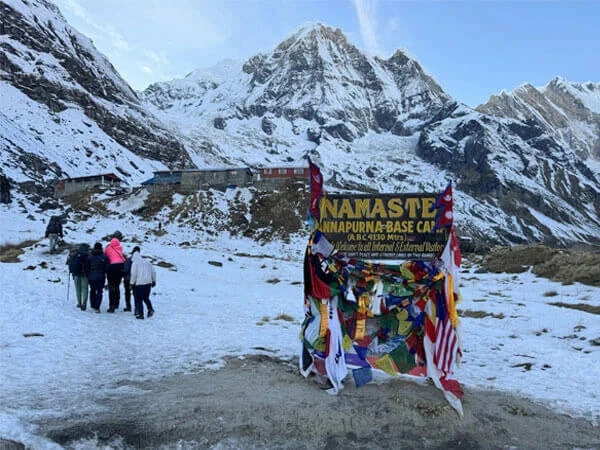
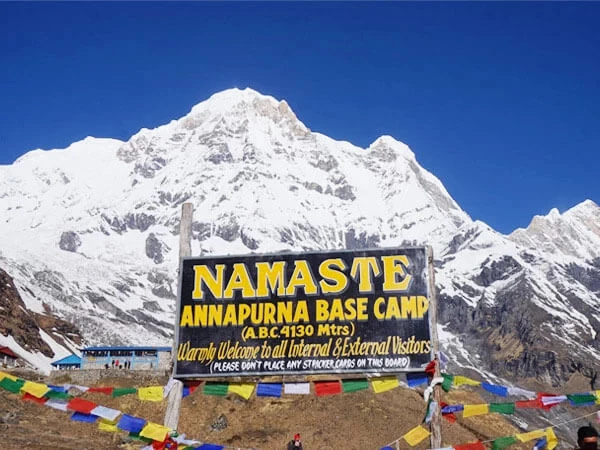
Annapurna Base Camp sits at 4,130 meters (13,550 feet) above sea level. That is the highest point of the entire ABC trek, the moment the Modi Khola gorge opens into a wide glacial bowl ringed by peaks over 7,000 and 8,000 meters. This high-altitude alpine destination serves as the focal point of the world-famous trekking route in the Himalayas of Nepal.
That single number answers the most searched question. But the elevation story behind ABC is what actually shapes your trek: how fast you climb to get there, how thin the air feels at the top, where Machhapuchhre Base Camp fits in, and why this trek is considered more beginner-friendly than Everest Base Camp despite both qualifying as high altitude.
Because this elevation officially pushes trekkers into the "high-altitude" zone, atmospheric pressure drops and oxygen levels decrease. It is heavily advised to ascend slowly, stay properly hydrated, and watch for symptoms of Acute Mountain Sickness (AMS) once you cross the 2,500-meter threshold.
Key Elevation Points on the Trek
Bamboo: 2,310 meters (7,579 feet)
Deurali: 3,230 meters (10,598 feet)
Machhapuchhre Base Camp: 3,700 meters (12,139 feet)
Annapurna Base Camp: 4,130 meters (13,551 feet)
Surroundings and Peak Heights
Annapurna I: 8,091 meters (26,545 feet) — the 10th highest mountain in the world.
Machhapuchhre (Fishtail): 6,993 meters (22,943 feet).
Annapurna South: 7,219 meters (23,684 feet).
How High Is Annapurna Base Camp? Is it higher than 4000 meters?
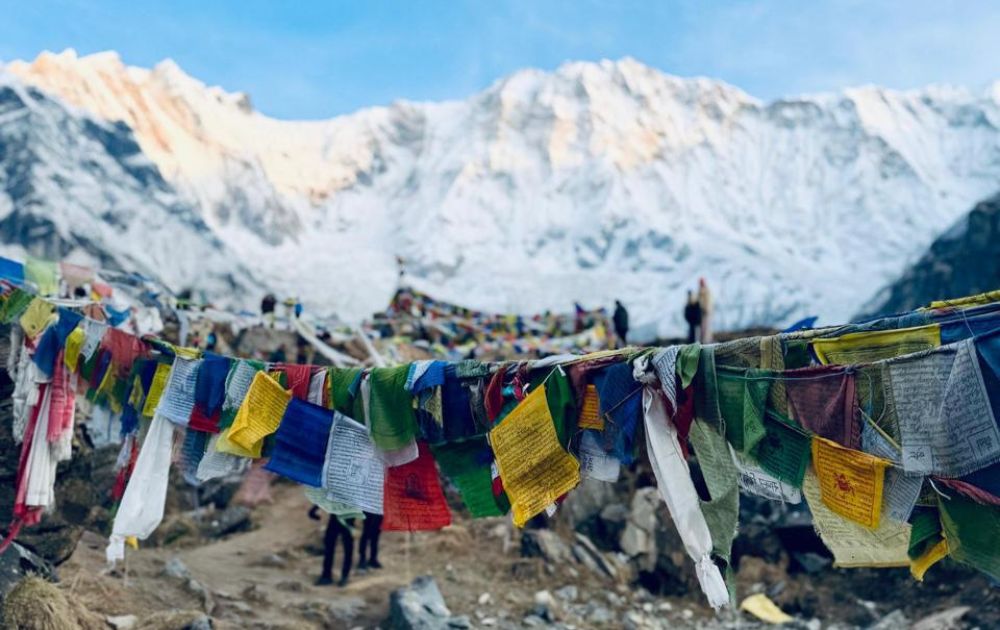
Annapurna Base Camp height: 4,130 meters (13,550 feet) above sea level. Located in the heart of the Annapurna Sanctuary in Nepal, it is the highest point of the iconic ABC trek and serves as the gateway to Annapurna I (8,091 meters).
|
Unit
|
Height
|
|
Meters
|
4,130 m
|
|
Feet
|
13,550 ft
|
|
Kilometers
|
4.13 km
|
|
Miles above sea level
|
2.57 miles
|
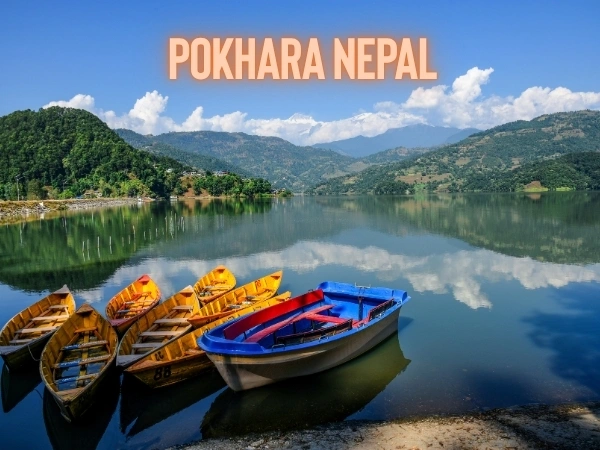
This is the maximum elevation on the standard ABC trek. Annapurna Base Camp sits at 4,130 metres within the Annapurna Conservation Area in Gandaki Province, central Nepal. The camp occupies a glacial basin carved by the Modi Khola valley and lies roughly 40 kilometres north of Pokhara and 200 kilometres northwest of Kathmandu.
At 4,130 meters, you are standing inside the Annapurna Sanctuary, a high glacial amphitheatre surrounded on all sides by towering peaks. Trekkers enter through a confined gorge along the Modi Khola, then emerge into an open basin where peaks rise 3,000 metres directly overhead on all sides.
The 4,130-meter figure is consistent across the Nepal government's conservation records, Wikipedia, and every major trekking authority. You will occasionally see it written as 4,095m or 13,549 feet depending on the exact survey point, but 4,130 meters is the standard reference.
The Annapurna Sanctuary: Where ABC Actually Sits
Annapurna Base Camp does not stand alone. It sits at the head of one of the most distinctive geographical features in the Himalayas: the Annapurna Sanctuary.
Annapurna Base Camp (ABC) sits at 4,130 meters (13,550 feet) within the Annapurna Sanctuary, a high-altitude glacial basin located roughly 40 km north of Pokhara, Nepal. This dramatic "natural amphitheater" is heavily guarded by an imposing ring of 7,000-to-8,000-meter peaks.
The Annapurna Sanctuary is a high glacial basin lying 40 km directly north of Pokhara. This oval-shaped plateau sits at an altitude of over 4,000 metres, and is surrounded by a ring of mountains, the Annapurna range, most of which are over 7,000 metres, with the only entrance being a narrow valley.
That single narrow entrance is the Modi Khola gorge, flanked by Hiunchuli and Machhapuchhre. It is the only way in or out for trekkers, which gives the Sanctuary its enclosed, fortress-like character.
The peaks surrounding ABC are staggering:
|
Peak
|
Height
|
Note
|
|
Annapurna I
|
8,091m (26,545 ft)
|
10th highest mountain on Earth
|
|
Annapurna South
|
7,219m (23,684 ft)
|
Southern gateway peak
|
|
Machhapuchhre (Fishtail)
|
6,993m (22,943 ft)
|
Sacred, never officially summited
|
|
Hiunchuli
|
6,441m (21,132 ft)
|
Southern gateway peak
|
The Sanctuary has deep cultural significance too. The local Gurung people consider it a sacred, hidden world where deities reside, and trekkers are expected to respect certain cultural taboos here. Machhapuchhre, the distinctive fishtail peak, is believed to be the home of Lord Shiva, which is why it has never been officially climbed to the summit.
There is genuine history in how this place was first reached. The Sanctuary was not penetrated by outsiders until 1956 when Colonel Jimmy Roberts, reconnoitring the approach to Machapuchare, reached the area after spending three days climbing through the gorge of the Modi Khola after leaving the village of Chomrong. That same gorge is the one trekkers walk today.
ABC Trek Elevation Profile: Every Milestone
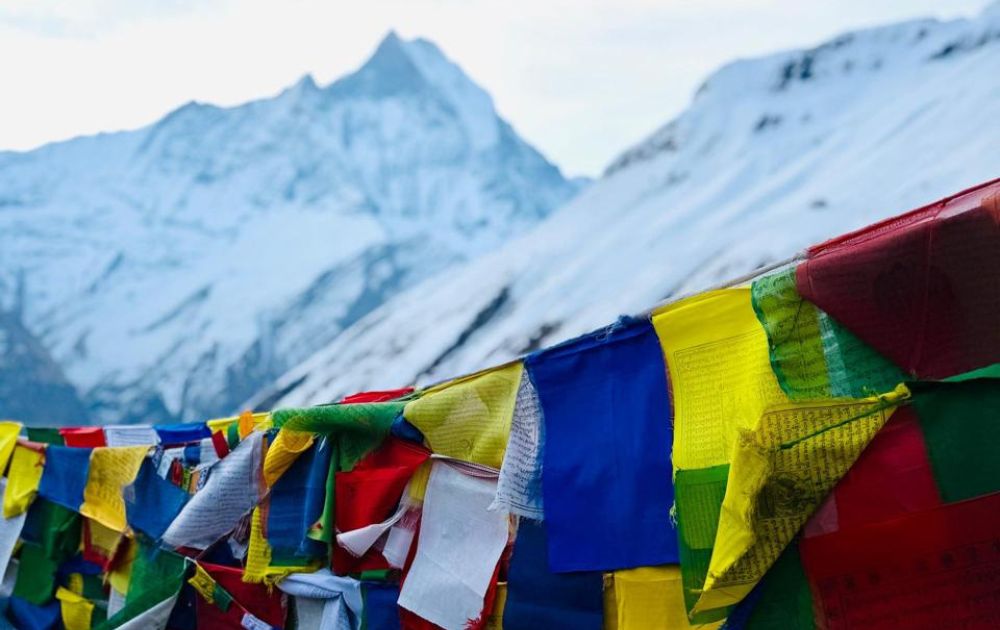
The defining feature of the ABC trek is its range. You start in warm subtropical valleys and climb into a cold, alpine glacial basin in a matter of days.
The Annapurna Base Camp (ABC) trek is a classic Himalayan journey that takes you from subtropical valleys at 820 m in Pokhara to the high-altitude alpine amphitheater of ABC at 4,130 m. The entire route is famously known for its "staircase profile," meaning you will experience constant ups and downs rather than a continuous, gentle climb.
|
Location / Landmark
|
Elevation (Meters)
|
Elevation (Feet)
|
Significance
|
|
Pokhara
|
822m
|
2,696 ft
|
Lakeside gateway city; drive to trailhead
|
|
Nayapul / Birethanti
|
1,050m
|
3,445 ft
|
Traditional starting point
|
|
Ulleri
|
1,960m
|
6,430 ft
|
The grueling 3,300+ stone step staircase
|
|
Chhomrong
|
2,170m
|
7,119 ft
|
Gurung village, gateway to Modi Khola valley
|
|
Ghorepani
|
2,874m
|
9,429 ft
|
Major overnight stop, access to Poon Hill
|
|
Himalaya
|
2,920m
|
9,580 ft
|
Tree line ends, alpine terrain begins
|
|
Poon Hill
|
3,210m
|
10,531 ft
|
Iconic sunrise viewpoint
|
|
Deurali
|
3,230m
|
10,597 ft
|
Entry to the high-altitude zone
|
|
Machhapuchhre Base Camp (MBC)
|
3,700m
|
12,139 ft
|
Final major teahouse before the top
|
|
Annapurna Base Camp (ABC)
|
4,130m
|
13,550 ft
|
The highest point of the trek
|
The total elevation gain from the trailhead to ABC is roughly 3,000 to 3,300 meters. Elevation rises from Pokhara at 940 meters to Annapurna Base Camp at 4,130 meters in 5 to 6 days. ABC elevation change isn't optimal, but the highest point on the trek is considerably lower than other major treks in Nepal, many of which reach 5,000 meters or more. Trekkers should follow closely the rules of acclimatization.
ABC Elevation Section by Section
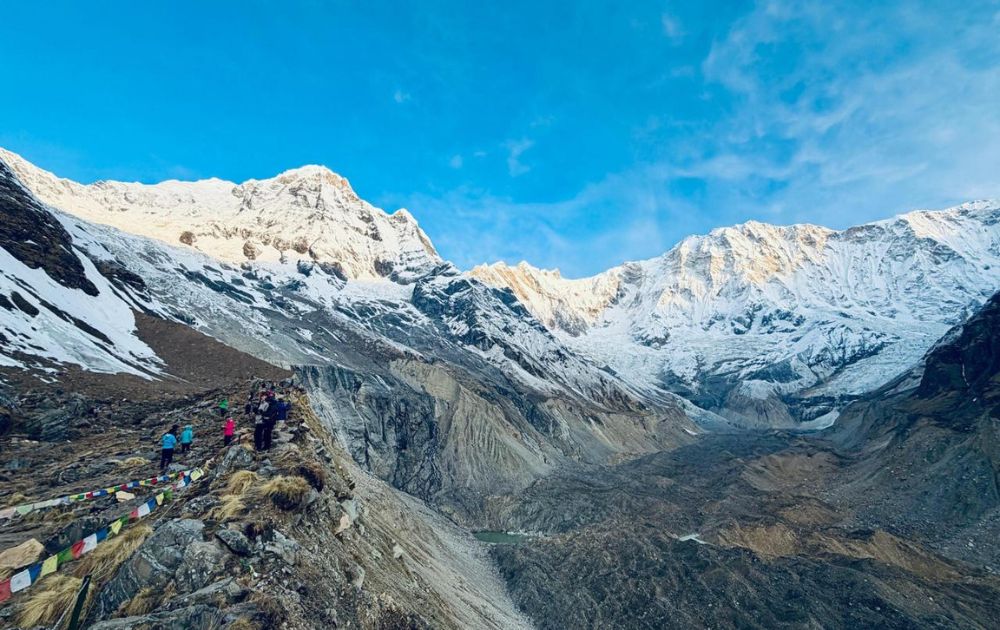
The Foothills and Ridges (1,000m to 2,800m)
- Nayapul / Birethanti: 1,070 m - The official starting point of the trail, surrounded by sub-tropical farmlands and riverbanks.
- Ulleri: 2,050 m - This section is notorious for pushing trekkers' legs with a steep, sustained climb featuring over 3,000 hand-cut stone steps.
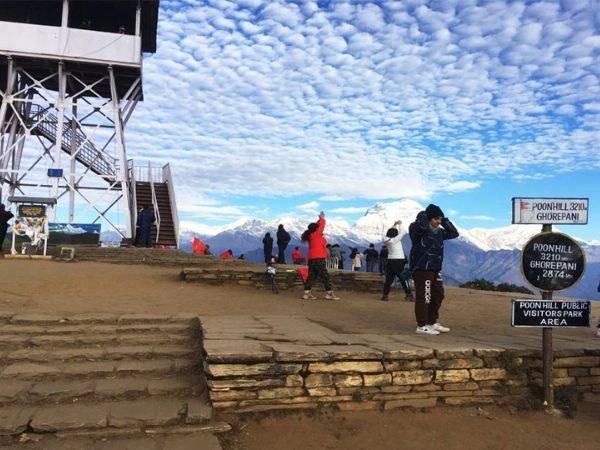
- Ghorepani & Poon Hill: 2,874 m to 3,210 m - A steady mountain climb brings you to the famous Ghorepani ridge, followed by a pre-dawn climb to Poon Hill for panoramic sunrise views.
The Modi Khola Valley Gorge (2,100m to 3,200m)
- Tadapani, Chuile, & Chhomrong: 2,630 m to 2,170 m - The trail descends steeply through rhododendron forests before ascending up to the large, inhabited Gurung village of Chhomrong.
- Bamboo to Dovan: 2,310 m to 2,600 m - The route drops down to the river to enter the narrow, heavily forested Modi Khola gorge, gradually climbing past bamboo and rhododendron forests.
- Himalaya to Deurali: 2,920 m to 3,230 m - A challenging, steeper ascent where the landscape becomes increasingly rugged and shifts from forest to alpine terrain.
The Alpine Zone and Base Camps (3,200m to 4,130m)
- Once you pass Deurali at 3,230m, you officially enter the high-altitude zone where Acute Mountain Sickness becomes a real risk.
- The approach to MBC (3,700m): The valley opens into a wide, windswept riverbed. Walking becomes physically more demanding as every breath yields roughly 35 percent less oxygen than at sea level.
- The final stretch to ABC (4,130m): The basin has two main camps: Machhapuchhre Base Camp at 3,700m and Annapurna Base Camp at 4,130m. The 2 to 3-hour hike from MBC to ABC climbs an additional 430 meters along a glacial moraine. At the top, you are surrounded 360 degrees by peaks exceeding 7,000 and 8,000 meters.
Oxygen and Altitude at 4,130 Meters
The altitude of Annapurna Base Camp has a direct effect on your body, even though it sits lower than Everest Base Camp.
At 4,130 meters (13,550 feet), the famous elevation of the Annapurna Base Camp in Nepal, the atmospheric pressure drops significantly. While the percentage of oxygen in the air remains at 21%, the density of the air is roughly 13 percent lower, meaning your body takes in roughly 60% of the oxygen it would at sea level.
Your resting heart rate rises as your body works harder to deliver oxygen, and physical exertion that feels easy at home becomes noticeably harder. Because of this severe hypobaric hypoxia, your cardiovascular and respiratory systems must work much harder to supply your organs with sufficient oxygen.
While 4,130 meters is more accessible than Everest Base Camp (5,364m) or the Thorong La Pass (5,416m), it still qualifies as "very high altitude." The risk of altitude sickness is real above 3,000 meters, and ABC sits well above that line.
The 500-meter rule. Once above 3,000 meters, the guideline is to limit your net sleeping elevation gain to no more than 300 to 500 meters per night. Most standard ABC itineraries respect this by splitting the upper section into separate nights at Deurali or Himalaya, then MBC, before sleeping at ABC.
The rapid descent advantage. Here is the safety feature that makes ABC more forgiving than higher treks. If you show symptoms of altitude sickness at base camp, you can descend 1,000 meters down into the safety of the gorge within just 3 to 4 hours. That fast escape route is not available on treks like Everest Base Camp, where descent options are slower and more limited.
Planning a safe ascent requires hydration, a slow pace, and often an acclimatization strategy where you "climb high, sleep low". For comprehensive guidance on preparing for this elevation, consider reviewing the Center For Wilderness Safety for oxygen dynamics or Princeton University's Guide to High Altitude for managing altitude illnesses.
ABC vs Everest Base Camp: Altitude Comparison
One of the most common questions trekkers ask is how ABC compares to Everest Base Camp in terms of height and difficulty.
Everest Base Camp (EBC) is significantly higher and more physically strenuous than Annapurna Base Camp (ABC). EBC reaches an elevation of 5,364 m (17,598 ft) with a highest viewpoint at 5,545 m (18,193 ft), while ABC peaks at just 4,130 m (13,550 ft).
The altitude differences profoundly impact the difficulty, acclimatization requirements, and overall risk of altitude sickness (Acute Mountain Sickness) for each trek.
|
Factor
|
Annapurna Base Camp
|
Everest Base Camp
|
|
Maximum altitude
|
4,130m (13,550 ft)
|
5,364m (17,598 ft)
|
|
Total trek duration
|
7 to 12 days
|
12 to 16 days
|
|
Highest sleeping altitude
|
4,130m (ABC)
|
5,164m (Gorak Shep)
|
|
Oxygen at highest point
|
50% of sea level
|
50% of sea level
|
|
Acclimatization rest days
|
Often none required
|
Two standard rest days
|
|
Descent speed if ill
|
Fast, 1,000m in 3 to 4 hours
|
Slower, more limited
|
|
Difficulty rating
|
Moderate
|
Moderate to hard
|
|
Best for
|
Beginners, intermediate trekkers
|
Experienced or determined first-timers
|
ABC sits 1,234 meters lower than EBC at its highest point. That difference matters. The lower peak altitude, shorter duration, and faster descent route make ABC one of the most popular choices for first-time high-altitude trekkers in Nepal.
North ABC and South ABC: Clearing Up the Confusion
The main difference between the two routes is that South ABC is the classic, heavily commercialized teahouse trail, while North ABC is a newly opened, rugged, and highly isolated route. Both trails reach a similar elevation but approach entirely different faces of the same mountain.
Quick Comparison
|
Feature
|
South ABC (Classic)
|
North ABC (Maurice Herzog Trail)
|
|
Base Camp Altitude
|
4,130 m (13,550 ft)
|
4,190 m (13,746 ft)
|
|
Starting Point
|
Nayapul / Matkiu / Ghandruk
|
Tatopani / Upper Narchyang / Humkhola
|
|
Accommodation
|
Established, comfortable teahouses
|
Basic tents, campsites, or limited homestays
|
|
Crowds & Vibe
|
Highly crowded; social and lively
|
Very quiet; raw wilderness and solitude
|
|
Terrain & Trail
|
Stone steps, well-maintained paths
|
Off-the-beaten-path, steep, rocky ridges
|
|
Scenery Focus
|
Subtropical forests, local villages, 360° peaks
|
Deep gorges, massive waterfalls, North Face
|
South ABC: The Classic Sanctuary
The South route is the world-famous trek that snakes through the Annapurna Sanctuary.
- The Experience: It is highly commercialized and social. You will stay in fully equipped teahouses featuring extensive menus, hot showers, and Wi-Fi.
- The Trail: The path is clearly defined but features thousands of grueling stone steps. It begins near Pokhara and winds through major local cultural hubs like Ghandruk and Chhomrong.
- The Views: At the base camp, you stand inside a massive amphitheater surrounded 360-degrees by towering peaks, including Machhapuchhre (Fishtail) and Annapurna South.
North ABC: The Adventurous Wilderness
The North route follows the historic path used by Maurice Herzog during the 1950 expedition, the first successful climb of an 8,000m peak.
The Experience: It is a newly developed route with very little commercial footprint. You will leave internet access and standard facilities behind, sleeping primarily in tents or base camps
- The Trail: Starting from Beni or the off-road trailhead at Humkhola, the route moves through deep gorges carved by the Mistri Khola. The paths are far more demanding, primitive, and require good route navigation.
- The Views: The main highlight is the pristine Panchakunda Lake and an unmatched, dramatic view of the colossal, vertical North Face of Annapurna I, a vista very few trekkers ever get to see.
How Many Days to Reach Annapurna Base Camp Altitude?
The time to reach 4,130 meters depends on your chosen route and pace.
|
Itinerary Type
|
Days to ABC
|
Acclimatization Quality
|
|
Short direct route (from Jhinu/Siwai)
|
4 to 5 days up
|
Faster, less margin
|
|
Standard route
|
6 to 7 days up
|
Balanced
|
|
Route with Poon Hill detour
|
7 to 9 days up
|
Best acclimatization
|
Though shorter 5 to 7-day versions exist, they require longer walking hours and can feel intense, especially for first-time trekkers. On the other hand, 12-day itineraries offer a more relaxed pace, allowing better acclimatization and recovery.
The Poon Hill detour is worth mentioning specifically for altitude reasons. Taking a detour to Poon Hill (3,210 meters) early in the trek gently conditions your body for what lies ahead. It adds days and distance, but the gradual exposure to altitude before the final push to ABC genuinely helps.
Altitude Sickness on the ABC Trek: What to Know
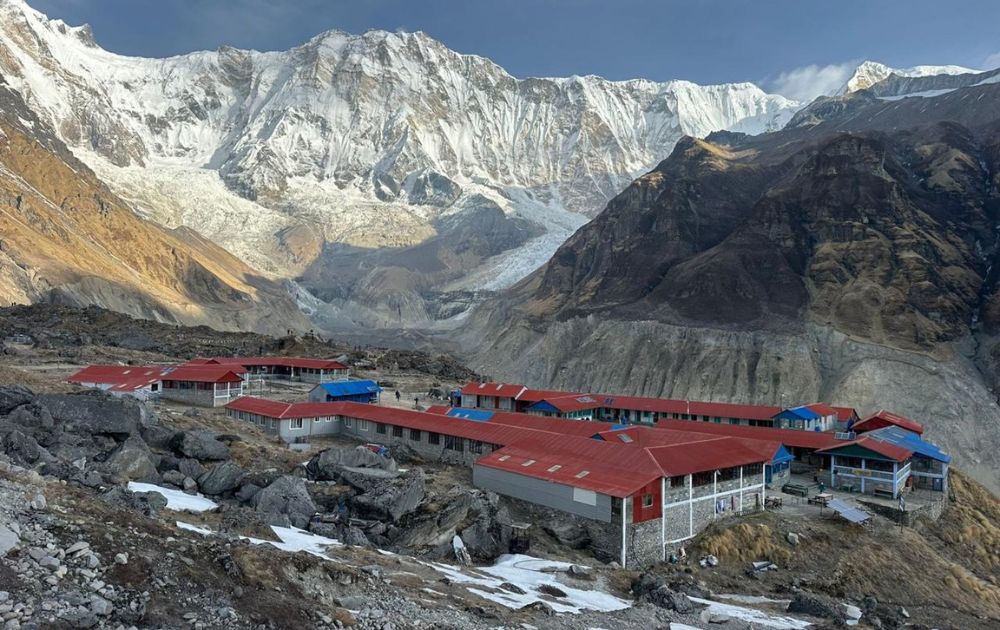
Altitude sickness, or Acute Mountain Sickness (AMS), is a real concern above 3,000 meters, and ABC sits at 4,130 meters. While altitude sickness is a much smaller risk on the Annapurna Base Camp (ABC) trek compared to Everest, it is still a real possibility. The trail peaks at 4,130 meters (13,550 feet), which is well above the threshold where Acute Mountain Sickness (AMS) can occur.
Common AMS symptoms:
- Headache that does not respond to rest or paracetamol
- Nausea and loss of appetite
- Dizziness and fatigue out of proportion to effort
- Difficulty sleeping
On the ABC trek specifically, the climb to Deurali typically causes the first symptoms of altitude sickness in unacclimatised trekkers, though most experience manageable thinness in air rather than debilitating breathlessness.
Prevention:
Drink 3 to 4 litres of water daily, starting before thirst develops, because altitude increases dehydration risk while reducing thirst sensation. Walk at a measured pace, eat balanced meals, and never ascend with worsening symptoms.
When to descend:
Immediate descent is necessary if you experience persistent vomiting, severe headache unrelieved by rest or medication, confusion, or difficulty walking straight. The nearest proper medical facility is in Pokhara, approximately 2 to 3 days' descent away, and helicopter evacuation costs exceed 5,000 dollars and depends on weather clearance.
This is exactly why the rapid descent route from ABC matters so much. Dropping 1,000 meters into the gorge within hours is often all the treatment mild AMS needs.
4,130 Meters to Feet: ABC Height Conversion Reference
|
Altitude (Meters)
|
Altitude (Feet)
|
Location
|
|
4,130m
|
13,550 ft
|
Annapurna Base Camp
|
|
3,700m
|
12,139 ft
|
Machhapuchhre Base Camp
|
|
3,230m
|
10,597 ft
|
Deurali
|
|
3,210m
|
10,531 ft
|
Poon Hill
|
|
2,920m
|
9,580 ft
|
Himalaya
|
|
2,170m
|
7,119 ft
|
Chhomrong
|
|
1,960m
|
6,430 ft
|
Ulleri
|
|
1,050m
|
3,445 ft
|
Nayapul
|
|
822m
|
2,696 ft
|
Pokhara
|
|
8,091m
|
26,545 ft
|
Annapurna I summit
|
The conversion is straightforward: one meter equals 3.28084 feet. So 4,130 meters multiplied by 3.28084 gives 13,549.6 feet, rounded to 13,550. You will see both 13,549 and 13,550 in different sources; both are correct depending on rounding.
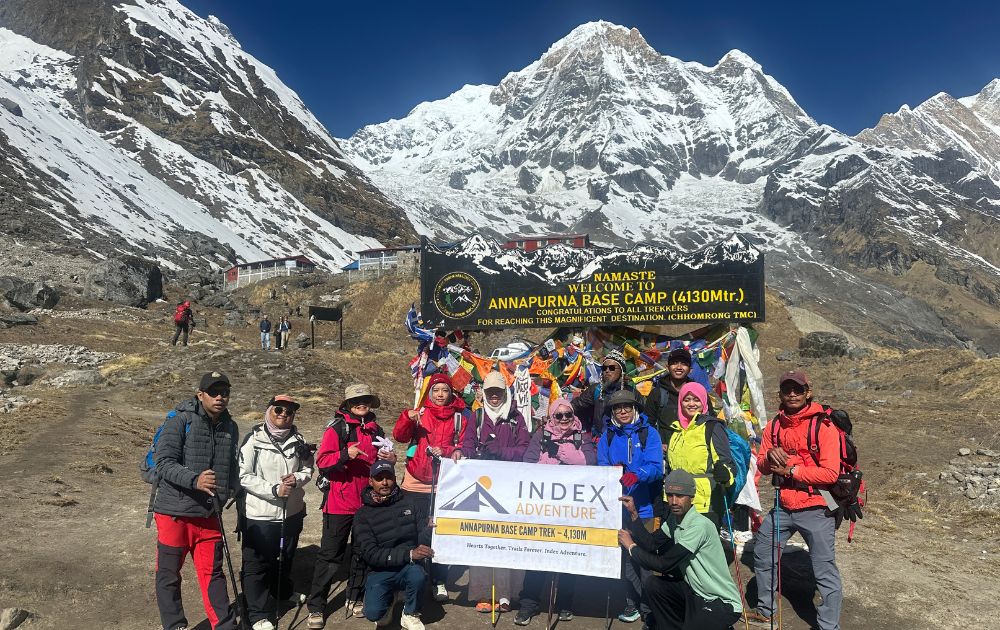
Annapurna Base Camp Height: Frequently Asked Questions
How high is Annapurna Base Camp?
Annapurna Base Camp sits at 4,130 meters (13,550 feet) above sea level. This is the highest point of the ABC trek.
What is the altitude of Annapurna Base Camp in meters?
4,130 meters above sea level, equivalent to 4.13 kilometers.
What is the height of Annapurna Base Camp in feet?
13,550 feet above sea level (sometimes written as 13,549 feet depending on rounding).
How tall is Annapurna Base Camp compared to Everest Base Camp?
ABC is 4,130 meters. Everest Base Camp is 5,364 meters. ABC sits 1,234 meters lower, which makes it more accessible for beginner and intermediate trekkers.
What is the highest altitude on the ABC trek?
Annapurna Base Camp at 4,130 meters is the highest point. If your itinerary includes the Poon Hill detour, you reach 3,210 meters there, but ABC remains the maximum elevation of the trek.
How much elevation do you gain on the ABC trek?
You gain roughly 3,000 to 3,300 meters total, climbing from around 820 to 1,050 meters at the trailhead to 4,130 meters at base camp.
What is the altitude of Machhapuchhre Base Camp?
Machhapuchhre Base Camp (MBC) sits at 3,700 meters (12,139 feet). It is the final major teahouse stop before the 430-meter climb to ABC.
How many feet is Annapurna Base Camp above sea level?
13,550 feet above sea level.
Is 4,130 meters dangerous?
It qualifies as "very high altitude," and altitude sickness is possible. However, ABC is considered more forgiving than higher treks because you can descend 1,000 meters to safety within 3 to 4 hours if symptoms appear.
What is the oxygen level at Annapurna Base Camp?
At 4,130 meters, the effective oxygen feels like roughly 13 percent, compared to 21 percent at sea level, or about 65 percent of sea-level oxygen availability.
How many days does it take to reach Annapurna Base Camp?
Depending on the route, 4 to 5 days on a short direct itinerary, 6 to 7 days on a standard route, or 7 to 9 days if you include the Poon Hill detour for better acclimatization.
Where is Annapurna Base Camp located?
In the Annapurna Sanctuary, a high glacial basin in Gandaki Province, northwestern Nepal, roughly 40 kilometers north of Pokhara. It faces Annapurna I (8,091m), the 10th highest peak in the world.
Planning Your ABC Trek
The altitude profile of the ABC trek is fixed. What changes from one trek to the next is how that profile is managed: whether the upper section is split correctly across Deurali, MBC, and ABC, whether the daily gain stays within the 500-meter rule, and how quickly a guide responds if someone's body struggles with the thin air at 4,130 meters.
Index Adventure runs guided ABC treks with experienced local guides who pace the upper section properly, carry the right safety equipment, and know exactly when to use the rapid descent route into the gorge if needed. Our itineraries build in acclimatization where it counts, so you arrive at 4,130 meters in good condition to actually enjoy the Sanctuary rather than just survive it.
If you are planning your ABC trek for the 2026 autumn season (September to November) or spring 2027 (March to May), departure dates are open for booking now