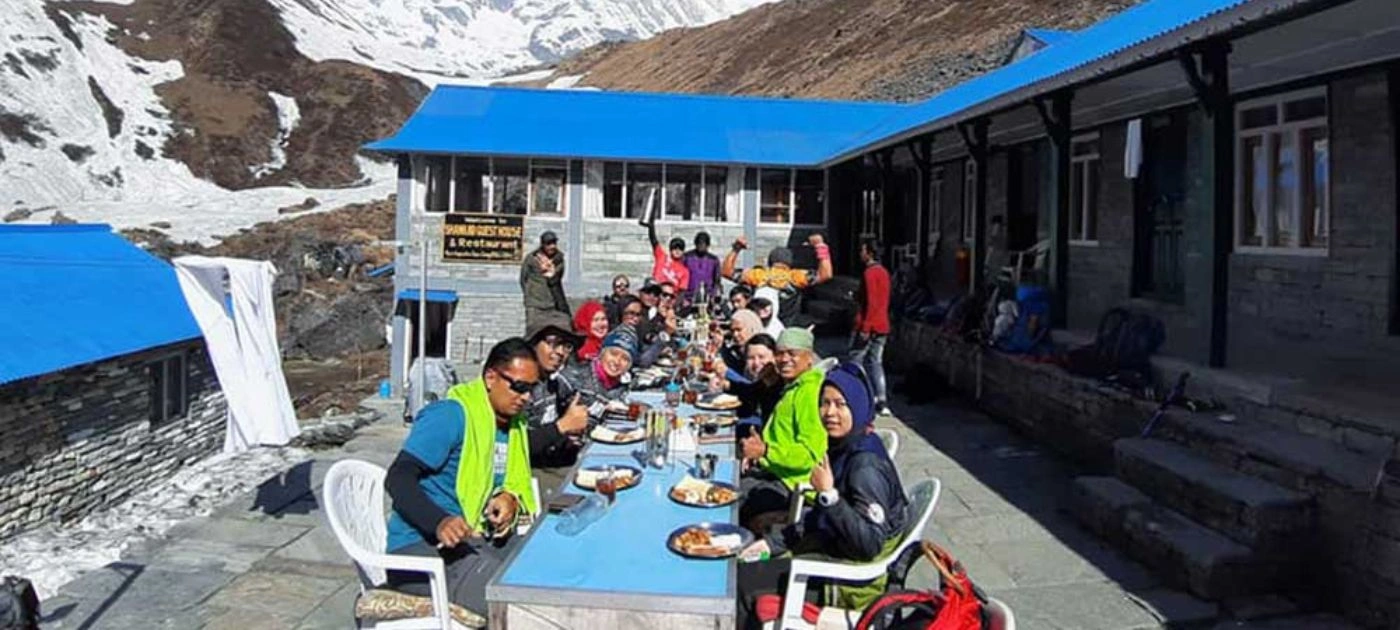
Food on the Annapurna Base Camp (ABC) trek is simple, filling, and built for altitude. You eat at family-run teahouses, the trailside lodges that serve as both your bed and your dining room, and the menu runs from Nepali staples like dal bhat and mo:mo to thukpa, fried rice, pasta, eggs, and pancakes. Budget 20 to 35 US dollars a day for meals, with prices rising step by step as you climb to Base Camp at 4,130 meters.
Here is the version trekkers actually experience. You will not go hungry, and you do not need to carry meals. The food is tasty and safe when you order well, though menus narrow and repeat the higher you go. Dal Bhat, with its free refills, is the nutritional foundation of the trek, and the bakery at Chhomrong is the most talked-about meal on the route. Three rules keep the food side easy: eat hot food, drink only treated water, and eat vegetarian above Chhomrong.
Quick trekker's recap:
- Daily food budget: 20 to 35 USD covers all meals. Budget trekkers manage on 18 to 25 USD.
- The vegetarian rule: eat vegetarian above Chhomrong (2,170 m). It significantly lowers your risk of foodborne illness at altitude.
- Dal Bhat first: order it for at least one meal a day for the best value, the best nutrition, and free refills.
- Water: drink 3 to 4 liters a day, all of it boiled or treated. Never drink untreated tap water.
- Best food on the trail: the Chhomrong bakery, known for cinnamon rolls, chocolate cake, apple crumble, and real coffee.
What food is available on the Annapurna Base Camp trek?
Teahouses serve a mix of Nepali, Tibetan, and basic Western food. The choice is widest at the lower villages and gets simpler the higher you climb, because the kitchen narrows to what is easy to carry, cook, and digest at altitude.
The everyday spread looks like this:
- Nepali staples: Dal Bhat (rice, lentils, curry, and pickle), vegetable curry, mo:mo, and dhido at some lodges.
- Tibetan warmers: thukpa, Sherpa stew, fried noodles, and Tibetan bread.
- Western comfort food: pasta, pizza, fried rice, French fries, sandwiches, porridge, muesli, and pancakes.
- Eggs in every style, potatoes in every form, and fresh bakery items at the lower villages.
Every plate is cooked to order and arrives hot. In a cold dining room at 3,200 meters, that matters for warmth and for hygiene.
What do trekkers really say about the food?
Trekkers rate the trailside cuisine as tasty and good for the conditions, praise the Chhomrong bakery and the Dal Bhat refills, and are honest that menus get repetitive and meat is risky at altitude.
What trekkers consistently praise:
- The Dal Bhat refill culture is real and valued. Guides and porters eat it twice a day, and most trekkers come around to it as the best fuel on the trail.
- The Chhomrong bakery is the food highlight of the route. After days of rice, the cinnamon rolls, chocolate cake, apple crumble, and real espresso are the most anticipated treat on the trek.
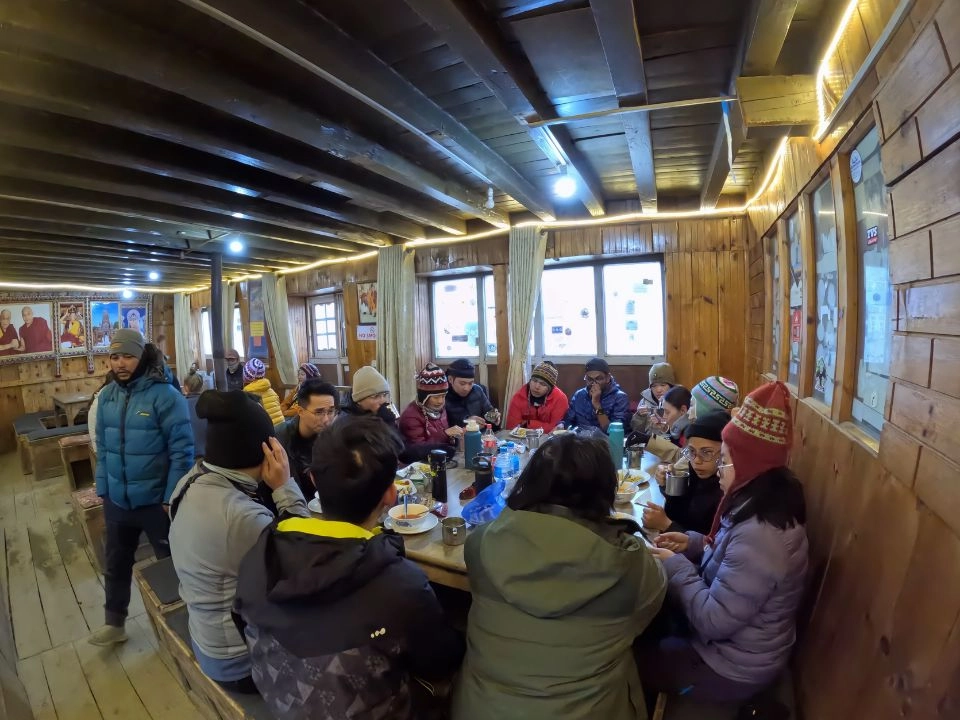
- The dining rooms are the heart of the experience. Warm stoves, shared tables, and conversation in many languages.
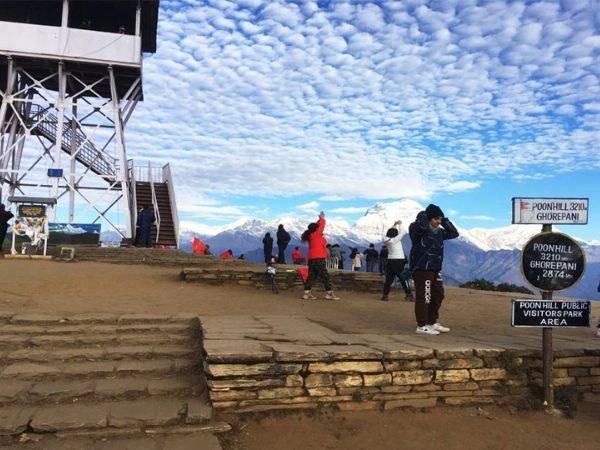
- Ghorepani earns repeat mentions for the best-value, most authentic Nepali food on the route.
What trekkers are honest about:
- Menus get repetitive by the end. The food is good for the conditions, but you will see the same items again and again.
- Prices climb steeply with altitude. A glass of hot water can reach 200 rupees high up, and bottled water can reach 400.
- Frozen meat at altitude can cause stomach problems. Trekkers who follow the vegetarian advice above Chhomrong report no issues.
Why is food so important on a high-altitude trek?
High-altitude trekking burns large amounts of energy while suppressing your appetite, so steady eating is what keeps you strong and safe. And with Annapurna Base Camp's height being at 4,130 meters with an average elevation of above 2,500 meters, it is very much important to have good food and stay hydrated. Most days on the Annapurna Base Camp trek run five to seven hours on stone steps and steep forest trails, and your appetite often shrinks just as your need for fuel grows.
Treat food as fuel. On our departures, the trekkers who eat well, hydrate well, and never skip a meal are the ones who reach the Sanctuary feeling strong. Carbohydrates do the work here. Rice, potatoes, noodles, and bread provide steady energy, while lentils, eggs, and beans support muscle recovery overnight. Most trekkers still lose a little weight because you burn more than you can comfortably eat. That is exactly why you should eat even when you do not feel hungry.
Why does food become more expensive at higher altitudes?
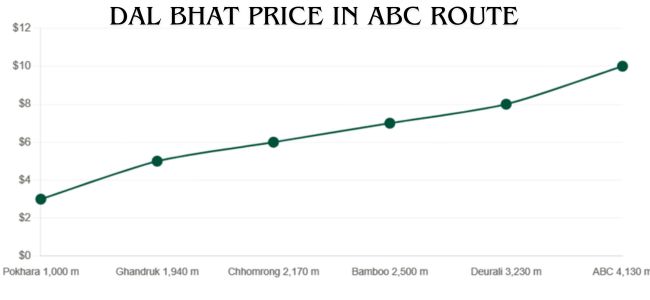
Prices rise because there are no roads above Chhomrong, and every ingredient is carried up by porter or mule. In the lower villages, supplies arrive on unpaved dirt tracks that are passable only by 4WD jeeps. Beyond the roadhead, the system changes completely.
A kilogram of rice costs around 80 rupees in Pokhara. By the time porters carry it to Annapurna Base Camp, that same kilogram can cost 200 rupees or more. When you pay extra at altitude, you are paying the people who carried it up the same stone steps you are climbing. The chart above maps how this plays out on a single plate of Dal Bhat, from about 3 dollars low on the trail to about 10 dollars at Base Camp.
What is Dal Bhat, and why do trekkers eat it twice a day?
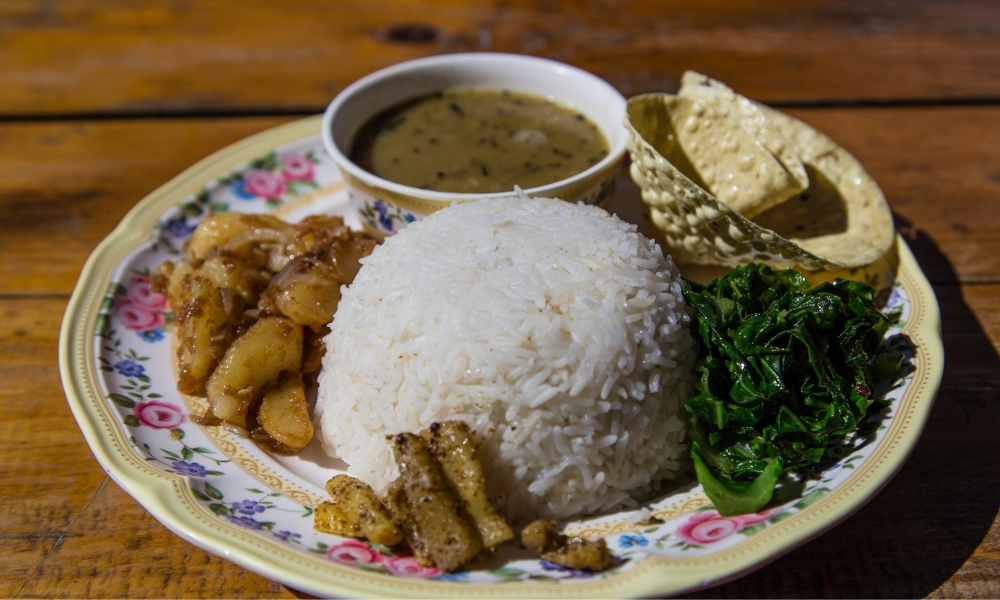
Dal Bhat is Nepal's national dish, a full plate of steamed rice (bhat), lentil soup (dal), seasonal vegetable curry (tarkari), cooked greens (saag), and a spicy pickle (achar). Trekkers eat it twice a day because it is balanced, freshly cooked at every lodge, available the entire route, and usually served with unlimited refills. Many know it by its full name, Dal Bhat Tarkari.
The slogan on the trail says it plainly: Dal Bhat Power, 24 Hours. The slow carbohydrates from rice and the protein from lentils give steady energy for a long walking day, and the warm, liquid format is gentle on a stomach that altitude has slowed.
A short history explains a lot about mountain menus. In the high hills, rice does not grow well, so families traditionally ate dhido, a thick porridge of millet, buckwheat, barley, or corn flour stirred into boiling water. You will still find dhido at some teahouses, often served with a local soup. It is the older, original staple of the Nepali hills, and it is worth trying once.
What can I expect for breakfast on the trail?
Breakfast is served between 6:30 and 7:30 a.m. and centers on carbohydrates: bread, eggs, porridge, and pancakes. Order it the night before to save time, since kitchens are busiest during peak season.
|
Breakfast option |
What it is |
Best for |
|
Tibetan or Gurung bread with eggs |
Thick fried flatbread, crisp outside, soft inside |
Maximum energy on a long day |
|
Porridge or muesli |
Oats with honey, milk, or dried fruit |
Easy digestion, steady fuel |
|
Pancakes |
Plain, banana, or apple, with honey or jam |
A lighter, sweet start |
|
Eggs (any style) plus toast |
Boiled, fried, scrambled, or omelette |
Protein and warmth |
|
Chapati or fried potatoes |
Whole-wheat flatbread or rosti-style potato |
Simple, filling, available high up |
A reliable combination is porridge plus eggs, or Tibetan bread plus eggs. You get carbohydrates for the climb and protein to hold you to lunch.
What is served for lunch and dinner?
Lunch and dinner share the same menu of dal bhat, mo:mo, noodle soups, fried rice, and Western comfort food. Lunch is a midday teahouse stop of 30 to 45 minutes, and dinner is eaten at the mountain lodge where you sleep, often around a wood or yak-dung stove.
The dishes you will see again and again:
- Dal Bhat: the best value and the smartest dinner choice, with refills.
- Mo:mo: Nepali dumplings filled with vegetables or potato and cheese, served with a spicy sauce.
- Thukpa and Sherpa stew: warming soups that are easy to digest on cold nights.
- Chow mein: stir-fried noodles, often made with WaiWai (a popular Nepali brand of instant noodles), with vegetables and egg.
- Fried rice, pasta, pizza, sandwiches, and French fries for familiar comfort.
A field habit from our guides: order Dal Bhat for at least one meal a day. Save the pizza and pasta for the lower lodges, where the kitchens have the ingredients to do them justice. At the lower villages you may also see buff (water buffalo meat) on the menu, served as curry or in mo:mo.
What snacks should I carry, and what local foods should I try?
Carry energy-dense snacks bought in Pokhara or Kathmandu, where they cost a fraction of the high-altitude price, and try local trail foods along the way. Aim to eat 200 to 300 calories every two hours on walking days to keep your energy level steady.
Standard trail snacks like chocolate bars, biscuits, roasted peanuts, and chips are sold at teahouse shelves all the way up, though prices rise sharply. Familiar options such as Snickers and Clif bars are easy to pack and reliable for a quick boost. Energy bars are limited on the trail, so stock those before you start.
For a real taste of Nepal, look for these:
- Churpi: a rock-hard cheese made from yak or cow milk, dried until it lasts for months. Trekkers keep a piece in the cheek and let it soften slowly over an hour. It is the original Himalayan trail snack and a good edible souvenir.
- Gundruk: fermented, sun-dried leafy greens with a tangy, sour bite, served as a side or in a warming soup.
- Sel roti: a ring-shaped, lightly sweet rice-flour doughnut, fried golden, more common around festival time.
Is there meat on the Annapurna Base Camp trek?
Mostly not above Chhomrong. The upper Annapurna Sanctuary is a sacred site to the local Gurung and Magar communities, who regard it as the home of Hindu and Buddhist deities, so the higher teahouses serve vegetarian menus only. Chhomrong (2,170 m) has traditionally been the last reliable point for chicken, mutton, and buff.
Our guidance is firm, and the reviews support it: eat vegetarian above Chhomrong. Fresh meat is hard to transport and store at altitude; it is usually served frozen, and it is the most common source of trail stomach trouble. Eggs, cheese, lentils, and beans cover your protein safely. Save the meat for the lower villages and your celebration meal back in Pokhara.
Meat safety protocol (if you do order meat at lower villages)
- Order meat only at the lower villages with road access, where supply turnover is fast.
- Choose dishes that are cooked thoroughly and served piping hot, never lukewarm.
- Ask the lodge whether the meat is fresh or frozen before ordering.
- Avoid meat that has been pre-cooked and left sitting.
- When in doubt at any elevation, choose Dal Bhat or another vegetarian dish.
How much does food cost on the Annapurna Base Camp trek?
Budget 20 to 35 USD per day for meals, and expect prices to rise with altitude. A plate of Dal Bhat runs about 3 USD low on the trail and up to 12 USD at Base Camp. The figures below are realistic 2026 planning ranges that vary by season and lodge.
|
Section (elevation) |
Dal Bhat (approx.) |
Notes on the menu |
|
Pokhara and Nayapul (820-1,070 m) |
2-4 USD |
Full menus, fresh meat, and baked goods. Stock up here. |
|
Ghandruk and Landruk (approx. 1,940 m) |
4-6 USD |
Widest teahouse variety on the lower trail. |
|
Jhinu and Chhomrong (1,780 - 2,170 m) |
5-7 USD |
Last reliable meat. The bakery at Chhomrong is the food highlight. |
|
Sinuwa, Bamboo, Dovan (2,340 - 2,520 m) |
6-8 USD |
Vegetarian menus. Carbohydrates dominate. |
|
Deurali (3,230 m) |
7-9 USD |
Simpler menus. Vegetarian, Vegan, and Gluten-free meals |
|
MBC and ABC (3,700 - 4,130 m) |
8-12 USD |
Highest prices, simplest food. Ginger tea and Dal Bhat lead the menu. |
For a daily budget, most trekkers fall into one of three bands:
|
Trekker style |
Daily food budget |
What it covers |
|
Budget (mostly Dal Bhat) |
18-25 USD |
Refillable staples, minimal extras |
|
Mid-range |
25-35 USD |
Mix of Nepali and Western food, a few hot drinks |
|
Comfort |
35-45 USD |
Western dishes, coffee, desserts, more drinks |
Carry enough cash for the whole trek in small bills before you leave Pokhara. There are no reliable ATMs past the city, and most teahouses do not accept cards.
What can I eat at each stop on the trail?
Variety shrinks and prices climb as you ascend, but every stop has something worth ordering. MBC below stands for Machhapuchhre Base Camp (3,700 m), the last overnight stop before ABC.
|
Stop (elevation) |
Food highlight |
What changes here |
|
Ghandruk and Landruk (approx. 1,940 m) |
Widest menu, fresh vegetables, meat, apple pie |
Busy trail junction; prices already above city rates |
|
Jhinu Danda (1,780 m) |
Dal Bhat, then natural hot springs near the lodges |
Steep climb to Chhomrong follows |
|
Chhomrong (2,170 m) |
The trail 's best bakery and last reliable meat |
Long stone-step descent after; last village before menus simplify |
|
Sinuwa, Bamboo, Dovan (2,340 - 2,520 m) |
Vegetarian Dal Bhat, WaiWai chow mein, Sherpa stew |
Menus narrow and start to feel repetitive |
|
Deurali (3,230 m) |
Garlic and Lentils soup from here up; |
Appetite begins to dip; carbohydrate meals are easiest |
|
MBC and ABC (3,700 - 4,130 m) |
Dal Bhat, thukpa, hot ginger tea at sunrise |
Smallest menu, highest prices, crowds at sunrise |
How do I stay hydrated, and what should I drink?
The Plastic Bottle Ban - No plastic water bottles or any plastic items are available to buy/sell
To combat pollution and manage waste in the fragile Himalayan ecosystem, disposable plastic mineral water bottles are banned in many parts of the Annapurna Conservation Area, especially as you climb higher. You cannot rely on buying standard plastic bottled water along the trail.
Drink 3 to 4 liters of water a day, all of it boiled or treated. Dehydration is one of the biggest drivers of altitude sickness, because dry air, hard breathing, and effort pull fluid out of you faster than you notice. The CDC's guidance on food and water safety is a useful pre-trip read for high-altitude travel.
The hot drinks on the trail help you hydrate and digest as much as they warm you:
- Nepali masala tea, milk tea, and black tea: the everyday warmers.
- Ginger tea and lemon tea: light and easy on the stomach.
- Lemon ginger tea: a favorite for easing cold symptoms and altitude discomfort.
- Garlic soup: a traditional Himalayan remedy our guides recommend at dinner from Deurali upward, believed to support acclimatization.
Never drink untreated tap water, no matter how clear it looks. The table below compares your safe options. We provide a Katadyn filter on our trips so you always have a backup.
|
Method |
How it works |
Cost |
Pros |
Cons |
|
Boiled water (teahouse) |
Water boiled in the lodge kitchen |
100-250 NPR/liter |
Reliable, kills pathogens, no plastic waste |
Costs more with altitude; wait time |
|
Purification tablets |
Chemical treatment (chlorine or iodine) |
Cheap, light to carry |
Effective, packable backup |
30-minute wait; slight aftertaste |
|
UV purifier (SteriPen) |
UV light kills microorganisms |
Higher upfront |
Fast, no taste, reusable |
Needs batteries; not for cloudy water |
|
Portable filter (Katadyn, LifeStraw) |
Physical filtration of bacteria and sediment |
Higher upfront |
Reusable, works on taps and streams |
Does not remove viruses alone |
Water purification tablets and iodine are provided by Index Adventure for all guests during the trek, ensuring you have a safe and constant supply of clean drinking water.
Note on alcohol: Skip it entirely above 3,000 meters. Beer and the local millet tongba are fine at the lower lodges, but at altitude alcohol dehydrates you and worsens altitude sickness.
What are the vegetarian, vegan, and gluten-free options?
Nepali cuisine is naturally plant-based friendly, so vegetarian, vegan, and gluten-free trekkers all eat well with clear communication. Dal bhat, vegetable mo:mo, fried rice, chowmein, potato curry, and seasonal vegetable soups are filling and available everywhere. Above Deurali, the food becomes simpler and more naturally plant-based by default.
Vegans can manage well with a little planning. Many dishes can be made without dairy: Dal Bhat without ghee, fried noodles with vegetables, boiled potatoes, and vegetable curries. State clearly that you avoid all animal products, including eggs, butter, milk, and honey, since saying "no meat" in Nepal does not automatically mean no eggs or dairy. Carry extra vegan snacks like nuts and dried fruit from Kathmandu.
Gluten-free trekkers have solid choices too. Rice, rice noodles, and potato dishes are naturally gluten-free, and Dal Bhat without bread or papad works well. Small teahouse kitchens make cross-contamination likely, so communicate your needs at every meal and pack a few safe snacks of your own. Nut allergies are lower risk here, since nuts are uncommon in trail cooking, but tell your guide before the trek so they can brief each lodge.
What foods should I avoid at altitude?
Avoid meat high on the trail, raw salads, alcohol above 3,000 meters, and excess caffeine. These four choices cause most of the avoidable stomach and altitude trouble on the route.
- Meat high on the trail: limited refrigeration means freshness is not guaranteed, and it is the most common source of trail stomach problems.
- Raw salads and unwashed vegetables: often rinsed in untreated water. Stick to cooked food above Ghandruk.
- Alcohol: avoid it entirely above 3,000 meters.
- Excess caffeine: one coffee a day is fine, but more disrupts the sleep your body needs to recover.
Expect your appetite to fade as you climb. It usually starts around Deurali and 3,500 meters, on the way to MBC, and reduced appetite is an early sign of mild altitude sickness. Do not ignore it. Keep eating 200 to 300 calories every couple of hours, lean on warm soups and porridge, and keep drinking.
If symptoms build, your guide will adjust the plan, and even a short descent to Deurali or Dovan usually helps quickly. Staying an extra night at MBC rather than pushing straight to ABC is one of the best acclimatization decisions on this route.
Is Mad Honey Available on Annapurna Base Camp Trekking Route?
While the Annapurna region is famous for its wild Mad Honey (locally known as Bhir Maha or Cliff Honey), finding it and purchasing it directly on the main Annapurna Base Camp (ABC) trail can be a bit tricky.
You will rarely see authentic mad honey sitting on a shelf in a teahouse once you pass Chomrong or enter the higher sanctuary (Bamboo, Sinuwa, or Deurali cliff), as it's too valuable a commodity.
Certified Shops in Pokhara or Kathmandu: Because the tourist market is flooded with fake "mad honey" (which is often just regular honey mixed with sugar syrup), buying it off a random trail vendor is risky. It is highly recommended to wait until you are back in Pokhara or Kathmandu, where specialized shops source it directly from the honey-hunting cooperatives. You can look out for places like the Annapurna Honey Center in Pokhara (near Lakeside).
Because harvesting it requires local hunters to hang from 300-foot-high cliffs on handmade hemp rope ladders while fighting off swarms of giant bees, it is expensive.
Is it okay to consume Mad Honey?
Authentic mad honey is a powerful traditional medicine. If you manage to taste it or buy some, never consume more than one teaspoon at a time. An overdose leads to "mad honey poisoning," causing severe drops in blood pressure, dizziness, vomiting, and heart arrhythmias—something you absolutely do not want to experience while isolated at high altitudes in the Himalayas!
What does a typical day of eating look like during the trek?
A balanced trail day pairs a carbohydrate breakfast, a hot lunch, an early refillable dinner, and steady snacks and warm drinks between. The sample plan below keeps your energy level even from morning to night.
|
Time |
Meal |
Suggested order |
|
6:30 - 7:30 a.m. |
Breakfast |
Porridge with honey, plus two eggs and Tibetan bread |
|
9:30 a.m. |
Snack |
Chocolate bar or a handful of peanuts |
|
12:00 - 1:00 p.m. |
Lunch |
Dal Bhat with refills, or vegetable thukpa |
|
3:00 p.m. |
Snack |
Energy bar and ginger or lemon tea |
|
5:30 - 6:30 p.m. |
Dinner |
Dal Bhat or Sherpa stew, with garlic soup from Deurali up |
|
Evening |
Drinks |
Masala tea or hot lemon; skip alcohol above 3,000 m |
What lodge facilities and trail etiquette should I know?
Teahouses are basic and earn their income from food, so eat where you sleep, expect cold rooms, and budget for charging and WiFi. Understanding the system makes the whole trek smoother.
On etiquette, the rule across the trail is to have your meals at the lodge where you stay the night. Rooms are kept cheap precisely because teahouses earn from food sales, and eating elsewhere for a cheaper plate has a direct financial impact on the family hosting you.
On facilities, plan for the following:
- Heating lives in the dining room only. Individual rooms are unheated, and nights at Deurali and above can drop to -10 to -15°C.
- Charging and WiFi cost extra, usually 100 to 500 rupees, and become unreliable higher up where power is solar.
- Water can freeze overnight at the higher lodges, so fill bottles before bed.
- Rooms are first come, first served in peak season. Book ahead or start early, since latecomers at ABC or MBC sometimes sleep on foam mats in the dining hall.
- Chhomrong is the last place with a free (solar, afternoon) hot shower.
For the current rules on permits and the mandatory licensed guide, check the Nepal Tourism Board's official trekking regulations before you travel.
What other treks should I consider after ABC?
If the teahouse dining on the Annapurna Base Camp trek leaves you wanting more, the natural next step is the Everest Base Camp trek. The food culture is similar, built on Dal Bhat, thukpa, and warm dining rooms, but the route is longer, higher, and reaches the foot of the world's tallest mountain. It costs more, partly because of the Lukla flight and tougher logistics, which is why many trekkers do Annapurna Base Camp first and Everest second.
Other strong options with the same teahouse experience:
- Annapurna Circuit: longer and more varied, often called the Apple Pie Trek for the orchards and bakeries of Marpha and Jomsom.
- Mardi Himal: a shorter, quieter ridge trek with the same Annapurna food and far fewer crowds.
- Langtang Valley: known for its local cheese and Tamang hospitality, close to Kathmandu.
- Manaslu Circuit: remote and rewarding, with simpler lodges and a real sense of distance.
We run all of these at Index Adventure, and our guides can match the right trek to your time, fitness, and appetite for altitude.
Plan your Annapurna Base Camp trek with Index Adventure
Knowing the food is one piece of a smooth trek. The rest is planning: an itinerary built for proper acclimatization, a licensed guide (now required by law for foreign trekkers in Nepal's conservation areas), and lodges booked ahead in peak season.
On our Annapurna Base Camp departures, three daily meals are included on the trail, your guide and porter handle the logistics, and we carry a water filter so hydration is never a worry. We plan steady pacing and enough rest because the trekkers who eat, drink, and walk at the right rhythm are the ones who stand in the Sanctuary feeling strong. If you want a route built around your dates and fitness, our team is ready to help.
Frequently Asked Questions
What is the best food to eat on the Annapurna Base Camp trek?
Dal Bhat is the best choice. It is balanced, freshly cooked, available everywhere, and usually comes with free refills, which makes it the most cost-effective and energizing meal on the trail.
How much should I budget for food per day on the ABC trek?
Budget 20 to 35 US dollars a day. Budget trekkers eating mainly Dal Bhat manage on 18 to 25 dollars, while those ordering Western food, coffee, and treats spend 35 to 45 dollars.
Is the food safe to eat on the Annapurna Base Camp trek?
Yes, when you follow basic precautions. Eat hot, freshly cooked meals, avoid raw vegetables and meat at altitude, wash your hands, and drink only treated water. Most trekkers finish the route without stomach trouble.
Where is the best food on the trail?
The bakery at Chhomrong is the standout, known for cinnamon rolls, chocolate cake, apple crumble, and real coffee. Ghorepani is praised for the best-value authentic Nepali food.
Is tap water safe to drink on the ABC trek?
No. Never drink untreated tap water. Use boiled water from teahouses, purification tablets, a filter, or a UV purifier. Boiled water is the cheapest and most eco-friendly option.
Can vegetarians and vegans find enough food?
Easily. Nepali cuisine is naturally plant-based friendly, and dal bhat, mo:mo, fried rice, noodles, and vegetable soups are everywhere. Vegans should state clearly that they avoid eggs and dairy as well.
What is the national dish of Nepal?
Dal Bhat, a plate of steamed rice, lentil soup, vegetable curry, and pickles. In the high hills, the older staple is dhido, a thick porridge of millet or buckwheat.